As a sidebar to my investigation of the Bible's portayal of God's authority, I wanted to think a bit about the idea of the corruption of scripture.
Bart Ehrman has a book titled The Orthodox Corruption of Scripture. This is obviously a polemical title. It appeals to a paranoia in our culture. This idea of the orthodox corruption of scripture popped into my head tonight as I was reading Richard Nelson's The Historical Books. In the section I was reading, Nelson was talking about the historical development of biblical texts. Our modern idea of authorship is that of a single person sitting down and writing a book. But biblical books, Nelson says, tend to be products of a community over time. The text is tinkered with as needed before it reaches its canonical form. For most scholars, I take it, this is a commonplace.
So here's the thing. The title of Ehrman's book says that early orthodox Christians corrupted the scriptures. But I would claim that the orthodox community produced the scriptures. This is the way biblical books are "written", right? The community has a book that they use in their life of faith. Something isn't quite as the community believes it should be, so they fix it.
If we look at the biblical book, whatever it may be, as a book of faith meant to serve a community of faith then there is absolutely nothing wrong with the community tailoring that book to match its teaching. It's what we would expect. To say that the book was "corrupted" would seem to imply that there was an earlier time when an author produced a book that was flawless (dare I say "inerrant") in its portrayal of the earlier faith, and a later community with different faith changed it (thus introducing error).
The problem, I suspect, is that Ehrman wants to use the Bible as a historical source to establish facts about the early Christians, whereas the early Christians wanted to use it as a book of faith.
Obviously, if we were to start editing the Bible today to make it say what we wanted it to say, that would be a bit suspect. But at some point the process of redacting was not only permissible, but was in fact necessary to produce the optimal product. The question, I suppose, is what is the statute of limitations on making changes to Holy Scripture?
But I suspect this is a wrong approach to the question. More important is the intent. Is the Bible being changed to make it a more suitable source for winning an argument? (I think this is what Ehrman actually claims.) Or is it being tidied up to make it a more accurate reflection of the faith of the community?
Saturday, September 09, 2006
Friday, September 08, 2006
God's Authority in the Exodus
Well, at this rate I should be through the Bible within a few years. Anyway...
In the story of the Exodus the whole theme of human action versus the will of God breaks into open conflict. In the first couple of chapters, we get more of what we saw in Genesis. God promises the increase of Israel. Pharaoh decrees that they be kept in check. Not only does God prevail (in part due to faithful human actions), but Pharaoh's very decree leads to the positioning of Moses for his future calling.
Fast forward to Moses in the desert and we see a different mode of God's authority -- one that I passed over with Abraham when God wanted to destroy Sodom and Gommorah -- dialogue! God wants Moses to go to Pharaoh to deliver God's people. Moses doesn't want to. But rather than imposing his will (as he will with Pharaoh) God talks to Moses about it. Ultimately, Moses (like Abraham before him) gets a concession.
Then Moses goes and speaks to Pharaoh. There we learn that God's people talking to unbelievers isn't the way God exerts authority over them -- at least not in this case. So now the behind-the-scenes God of the Joseph story steps forward for an all-out smackdown.
In the Passover narrative, we get for the first time a hint of scripture making a self-reference. I've been studiously avoiding consideration of the implication of the author writing with the intention of having authority, because I wanted to wait and consider what the text itself says about itself. Exodus 12 doesn't quite give the people scripture but there is the first explicit reference to future generations being told of the things that are happening.
So, in what way does the tradition established mean to exercise authority? It says, "when your children ask, 'What do you mean by this observance?' you shall say, 'It is the passover sacrifice of the Lord, for he passed over the houses of the Israelites in Egypt, when he struck down the Egyptians but spared our houses.'" (Ex. 12:26-27) So, the intended use of the tradition is to cause future generations to remember the story of what happened. The next sentence is interesting. Moses has just finished speaking, giving instructions for the establishment of this tradition. As soon as he finishes speaking the next word of the text is this: "And the people bowed down and worshipped."
As the exodus proper comes to a close, I see this pattern developing: God's authority among the people of God is exercised primarily through God's words, whereas God's authority among the other peoples of the world is exercised primarily through what happens. This isn't always the way it works. God's authority among the sons of Jacob in the Joseph sequence is exercised through providence, and God's authority against Moses is asserted in word as well as deed. But it seems like a general trend.
God's words to the people have so far had the following basic forms: teaching (Adam and Cain), promise (Abraham, Sarah, Hagar, Isaac, Rebekah, Jacob, Joseph), dialogue (Abraham and Moses), and narrative. Of these, the narrative is the form most explicitly intended to influence future generations, and the intended influence is simply remembering of the story.
In the story of the Exodus the whole theme of human action versus the will of God breaks into open conflict. In the first couple of chapters, we get more of what we saw in Genesis. God promises the increase of Israel. Pharaoh decrees that they be kept in check. Not only does God prevail (in part due to faithful human actions), but Pharaoh's very decree leads to the positioning of Moses for his future calling.
Fast forward to Moses in the desert and we see a different mode of God's authority -- one that I passed over with Abraham when God wanted to destroy Sodom and Gommorah -- dialogue! God wants Moses to go to Pharaoh to deliver God's people. Moses doesn't want to. But rather than imposing his will (as he will with Pharaoh) God talks to Moses about it. Ultimately, Moses (like Abraham before him) gets a concession.
Then Moses goes and speaks to Pharaoh. There we learn that God's people talking to unbelievers isn't the way God exerts authority over them -- at least not in this case. So now the behind-the-scenes God of the Joseph story steps forward for an all-out smackdown.
In the Passover narrative, we get for the first time a hint of scripture making a self-reference. I've been studiously avoiding consideration of the implication of the author writing with the intention of having authority, because I wanted to wait and consider what the text itself says about itself. Exodus 12 doesn't quite give the people scripture but there is the first explicit reference to future generations being told of the things that are happening.
So, in what way does the tradition established mean to exercise authority? It says, "when your children ask, 'What do you mean by this observance?' you shall say, 'It is the passover sacrifice of the Lord, for he passed over the houses of the Israelites in Egypt, when he struck down the Egyptians but spared our houses.'" (Ex. 12:26-27) So, the intended use of the tradition is to cause future generations to remember the story of what happened. The next sentence is interesting. Moses has just finished speaking, giving instructions for the establishment of this tradition. As soon as he finishes speaking the next word of the text is this: "And the people bowed down and worshipped."
As the exodus proper comes to a close, I see this pattern developing: God's authority among the people of God is exercised primarily through God's words, whereas God's authority among the other peoples of the world is exercised primarily through what happens. This isn't always the way it works. God's authority among the sons of Jacob in the Joseph sequence is exercised through providence, and God's authority against Moses is asserted in word as well as deed. But it seems like a general trend.
God's words to the people have so far had the following basic forms: teaching (Adam and Cain), promise (Abraham, Sarah, Hagar, Isaac, Rebekah, Jacob, Joseph), dialogue (Abraham and Moses), and narrative. Of these, the narrative is the form most explicitly intended to influence future generations, and the intended influence is simply remembering of the story.
Wednesday, September 06, 2006
The Stories of the Patriarchs
The stories of the partriarchs are somewhat less mythical in quality than the stories in Genesis 1-11, though the people involved are in many ways personification of later Israel (Jacob explicitly so). Curiously, they get precious little that could be characterized as "teaching" from God. Instead, the operative mode of God's authority in these stories is promise, though again with generous portions of providence.
The promises of God given to Abraham, Isaac and Jacob aren't just information sprinkled into the narrative, they create the action. They are a means by which God brings his will to pass. I tend to think of Abraham as someone who heard from God all the time, but the text doesn't actually support this. Abraham only gets a few brief visits from God over the course of about 10 years and the few words he recieves must guide him.
But God isn't absent in between these theophanies. When Abram goes to Egypt and hands Sarai over to Pharaoh, God intervenes. I want to say "silently" but Pharaoh somehow knows why he suffered plagues. Likewise, when Abraham sends his servant to get a wife for Isaac, God acts without appearing.
The working out of Jacob's story is fasinating to me. While he's still in the womb, God gives Rebekah a promise concerning Jacob. Then Rebekah and Jacob lie, cheat and steal to bring about what God promised. Jacob's relationship with God is summed up in the incident where he wrestles to get a blessing. It seems to me God was determined to bless him either way, but at times the wrestling seems to unwittingly play into the will of God.
This theme finally bursts fully into view in the Joseph sequence. God reveals his will to Joseph in a dream. Everything in Joseph's life conspires against God's disclosed intentions, and it turns out all of it has turned out to bring about God's will.
So my conclusion is that in Genesis 12-50, the authority of God is exercised in two ways: divine promise and divine providence. As in chapters 1-11, God's authority in the world is seen primarily through direct action which come to pass regardless of human effort for or against them, but God's will enters individual lives through God's word.
The promises of God given to Abraham, Isaac and Jacob aren't just information sprinkled into the narrative, they create the action. They are a means by which God brings his will to pass. I tend to think of Abraham as someone who heard from God all the time, but the text doesn't actually support this. Abraham only gets a few brief visits from God over the course of about 10 years and the few words he recieves must guide him.
But God isn't absent in between these theophanies. When Abram goes to Egypt and hands Sarai over to Pharaoh, God intervenes. I want to say "silently" but Pharaoh somehow knows why he suffered plagues. Likewise, when Abraham sends his servant to get a wife for Isaac, God acts without appearing.
The working out of Jacob's story is fasinating to me. While he's still in the womb, God gives Rebekah a promise concerning Jacob. Then Rebekah and Jacob lie, cheat and steal to bring about what God promised. Jacob's relationship with God is summed up in the incident where he wrestles to get a blessing. It seems to me God was determined to bless him either way, but at times the wrestling seems to unwittingly play into the will of God.
This theme finally bursts fully into view in the Joseph sequence. God reveals his will to Joseph in a dream. Everything in Joseph's life conspires against God's disclosed intentions, and it turns out all of it has turned out to bring about God's will.
So my conclusion is that in Genesis 12-50, the authority of God is exercised in two ways: divine promise and divine providence. As in chapters 1-11, God's authority in the world is seen primarily through direct action which come to pass regardless of human effort for or against them, but God's will enters individual lives through God's word.
Monday, September 04, 2006
The Authority of Scripture
I've just begun reading N.T. Wright's The Last Word: Beyond the Bible Wars to a New Understanding of the Authority of Scripture. So far I've taken away from it two basic ideas:
With that I'll begin...
I am of the school that sees Genesis 1-11 as a sort of overture to the rest of the Bible, and my view of these chapters will be colored accordingly. I see these stories as more or less idealized settings intended to isolate certain aspects of the God-human relationship.
If I were a scholar I suppose I might separately investigate the views presented by J,E,D, and P and so on, but instead I'm a blog writer so I'll cavalierly lump them all together. But I digress....
Genesis 1 presents a perfect view of God's authority. God said, "Let there be light" and there was light. In chapter 2, a sublty is introduced, namely creation's dependence on God, "no herb of the field had yet sprung up—-for the Lord God had not caused it to rain upon the earth." So what happens happens by God's word, and nothing happens without God's word.
Here also we get a first image of God's authority exercised with respect to man. God's authority is exercised in the form of a command given to the man. Reading this through the lens of Israel's later worldview, I'm inclined to view this as God giving torah to the man, not strictly a command but rather teaching (still an insufficient word to replace torah). And when the man and the woman disregard this torah, God exercises authority through consequences. In chapter 4, Cain also receives a kind of torah from God (verses 6 and 7). Cain disregards the torah and God resorts to consequences.
With less thorough examination, I'll conclude that in chapter's 5 through 11 God continues to exercise authority over creation rather indirectly through what happens to the people. I'm not quite ready to start building a four-legged stool by saying that these people find God's authority through experience. Rather God's authority is exercised more or less independently of the people's perception of it. For instance, God wants the people to fill the earth (9:1). When the people in Babel build their tower "so that we do not get scattered all over the world" (11:4) God acts directly to cause their scattering.
This last conclusion may seem irrelevant to understanding how we can perceive and respond to God's authority, but perhaps that's the wrong way to approach the question. What I'm really seeking is an understanding of how God's authority is actually exercised and what the role of scripture might be within that.
Obviously, we have no scripture yet present to the people of Genesis 1-11, but I'm noting the torah given to Adam and Cain as a potential model for God exercising authority through scripture.
- The phrase "the authority of scripture" must be understood as shorthand for "the authority of God exercised through scripture."
- A properly developed understanding of the authority of scripture must be based in scripture.
With that I'll begin...
God's Authority in Genesis 1-11
I am of the school that sees Genesis 1-11 as a sort of overture to the rest of the Bible, and my view of these chapters will be colored accordingly. I see these stories as more or less idealized settings intended to isolate certain aspects of the God-human relationship.
If I were a scholar I suppose I might separately investigate the views presented by J,E,D, and P and so on, but instead I'm a blog writer so I'll cavalierly lump them all together. But I digress....
Genesis 1 presents a perfect view of God's authority. God said, "Let there be light" and there was light. In chapter 2, a sublty is introduced, namely creation's dependence on God, "no herb of the field had yet sprung up—-for the Lord God had not caused it to rain upon the earth." So what happens happens by God's word, and nothing happens without God's word.
Here also we get a first image of God's authority exercised with respect to man. God's authority is exercised in the form of a command given to the man. Reading this through the lens of Israel's later worldview, I'm inclined to view this as God giving torah to the man, not strictly a command but rather teaching (still an insufficient word to replace torah). And when the man and the woman disregard this torah, God exercises authority through consequences. In chapter 4, Cain also receives a kind of torah from God (verses 6 and 7). Cain disregards the torah and God resorts to consequences.
With less thorough examination, I'll conclude that in chapter's 5 through 11 God continues to exercise authority over creation rather indirectly through what happens to the people. I'm not quite ready to start building a four-legged stool by saying that these people find God's authority through experience. Rather God's authority is exercised more or less independently of the people's perception of it. For instance, God wants the people to fill the earth (9:1). When the people in Babel build their tower "so that we do not get scattered all over the world" (11:4) God acts directly to cause their scattering.
This last conclusion may seem irrelevant to understanding how we can perceive and respond to God's authority, but perhaps that's the wrong way to approach the question. What I'm really seeking is an understanding of how God's authority is actually exercised and what the role of scripture might be within that.
Obviously, we have no scripture yet present to the people of Genesis 1-11, but I'm noting the torah given to Adam and Cain as a potential model for God exercising authority through scripture.
Thursday, August 31, 2006
Friend of Sinners
In the postscript to Jesus the Jew, Geza Vermes, describing what is special about the teaching of Jesus says this:
I wonder if the oft-repeated dogma among the "respectable" that the best among us are wicked has undermined this openness to the ostracised. Too often the best we can muster is to say that "the wicked," though deserving of scorn, can stand beside us because, as we say, we are sinners too (though I think we scarely believe it). The very doctrine that often supports this "forgiveness", universal depravity, prevents us from considering the possibility that Jesus would see them as good.
The prophets spoke on behalf of the honest poor, and defended the widows and the fatherless, those oppressed and exploited by the wicked, rich and powerful. Jesus went further. In addition to proclaiming these blessed, he actually took his stand among the pariahs of his world, those despised by the respectable. Sinners were his table-companions and the ostracised tax-collectors and prostitutes his friends.
I wonder if the oft-repeated dogma among the "respectable" that the best among us are wicked has undermined this openness to the ostracised. Too often the best we can muster is to say that "the wicked," though deserving of scorn, can stand beside us because, as we say, we are sinners too (though I think we scarely believe it). The very doctrine that often supports this "forgiveness", universal depravity, prevents us from considering the possibility that Jesus would see them as good.
Respect for Human Life
In response to my recent Pro-Compassion post, Tom in Ontario offered a section from the Evangelical Lutheran Church in Canada's statement, "Stewards of Creation: Respect for Human Life". I liked it enough that I wanted to repost it. A lot of thought goes into these statements, and then they seem to get filed away and hardly thought about.
Also relevant, it seems to me, is the famous saying:
Our society does not provide adequate child care resources for the "working poor." Men are not always held responsible for the children they father. Until these systemic problems are dealt with, people will continue to decide that abortion is the least difficult of disturbing options. The economic system will need to be changed so as to encourage and support the choice not to abort.
How is abortion connected with violence in society? with our role in the world-wide arms race? with war around the world and spending priorities of governments? Our society doesn't consistently view life as a gift to be valued and a sacred trust in the true and complete sense.
If, as a society, we truly value life, then simply passing legislation which deals only with abortion per se will not solve our problem or express our value for human life. We must also address those social and economic structures which not make abortion a tragic necessity for some people. Such structures need to be changed. These changes would include (a) restructuring the social welfare system so that single mothers and their children are not trapped in poverty but have adequate economic and emotional support, (b) creating a system of public day care so that all children and parents have access to quality care at reasonable cost, (c) restructuring the child welfare system to provide stable and healthy nurture for all children, (d) creating systems which hold men as accountable as women for all children conceived, and (e) developing systems which provide appropriate medical, financial, and emotional care for all pregnant women. Simply ignoring or criminalizing abortion does not address the real issues. Rather, as Christians we ought to favour legislation which embodies value for human lives. We would especially favour legislation which might result in decreased violence against women and children.
Because we deeply respect human life, and as abortion involves ending a life process, abortion is a serious matter which reflects the complex nature of the human condition. While abortion may be deemed justifiable under exceptional conditions, we are called to explore redemptive alternatives that would eliminate the felt need for abortion.
As people of faith we must commit ourselves to pray for wisdom, guidance, understanding, and love for all who struggle with the reality of abortion; praise God by celebrating and demonstrating respect for human life in our worship, education, service, and outreach; proclaim in word and deed God's compassion for all.
Also relevant, it seems to me, is the famous saying:
Everybody talks about the weather, but nobody does anything about it.
Wednesday, August 30, 2006
The Great Commission
In my earlier post on evangelism, I complained about the brute-force tactics of evangelization by apologetics. I tend to have a rather strained relationship with evangelism anyway, and not just because I'm Lutheran. It's something I struggle with on multiple levels.
I touched on this in the comments on the other post, but it seemed worth dwelling on a little more. The Great Commission tels us, "Go and make disciples of all nations." We're not called to make "believers" but rather students. I think the model of a Christian and a Jew having lunch and discussing the teachings of their religions is a better model of discipleship than a guy in the public square handing out evanglism tracts.
But how convenient that it's also something that I'm more comfortable with. Am I turning a blind eye to something? Certainly what I've described isn't what we find in the book of Acts. And I do think that there's a place for missionary work.
It's been noted that North America and Europe are mission fields. But what methods apply? How do you share the gospel with people who already share your cultural history, who have not only heard that Jesus died for theirs sins but have also seen the works, both good and bad, of his followers?
I touched on this in the comments on the other post, but it seemed worth dwelling on a little more. The Great Commission tels us, "Go and make disciples of all nations." We're not called to make "believers" but rather students. I think the model of a Christian and a Jew having lunch and discussing the teachings of their religions is a better model of discipleship than a guy in the public square handing out evanglism tracts.
But how convenient that it's also something that I'm more comfortable with. Am I turning a blind eye to something? Certainly what I've described isn't what we find in the book of Acts. And I do think that there's a place for missionary work.
It's been noted that North America and Europe are mission fields. But what methods apply? How do you share the gospel with people who already share your cultural history, who have not only heard that Jesus died for theirs sins but have also seen the works, both good and bad, of his followers?
Pro-Compassion
In the parking lot at work this morning I saw one of those bumper stickers that says "Pro-Child, Pro-Choice" and it got me thinking about the whole abortion issue. I'm not really pro-choice, but I vote that way. Or at least I would vote that way if this were ever really an issue we were voting on.
As I was thinking about the issue today something occurred to me. Everyone knows that pro-life vs. pro-choice is a false dichotomy. What hit me today was that while I agree that life is sacred, I don't agree that choice is sacred. It just isn't. Yes, our national rhetoric says the right to liberty is one of the values on which this country was founded, but to the extent that that's true, it was basically an overstep. And yet I do come down on the "pro-choice" side of the argument because of something that is sacred to me -- compassion.
Does compassion ever justify the taking of nascent life? Probably not. But I'm not trying to justify abortion. I'm trying to find a position from which I could credibly speak to someone who felt she had no other choice. If only someone were formulating policies from this perspective....
As I was thinking about the issue today something occurred to me. Everyone knows that pro-life vs. pro-choice is a false dichotomy. What hit me today was that while I agree that life is sacred, I don't agree that choice is sacred. It just isn't. Yes, our national rhetoric says the right to liberty is one of the values on which this country was founded, but to the extent that that's true, it was basically an overstep. And yet I do come down on the "pro-choice" side of the argument because of something that is sacred to me -- compassion.
Does compassion ever justify the taking of nascent life? Probably not. But I'm not trying to justify abortion. I'm trying to find a position from which I could credibly speak to someone who felt she had no other choice. If only someone were formulating policies from this perspective....
Tuesday, August 29, 2006
Extended Music Meme
This meme comes by way of Lutherpunk and Here I Stand. It'll mostly confirm how boringly conventional I am. Oh well....
1. Of all the bands/artists in your cd/record collection, which one do you own the most albums by?
Hmmm.... I'm guessing it's either Led Zeppelin or Nine Inch Nails. I went through phases with both of them where I was buying all their stuff, but my Zeppelin albums seem to have a habit of disappearing, so it's probably NIN.
2. What was the last song you listened to?
Ohio by Neil Young
3. What's in your record/cd player right now?
Physical media is so retro. I'm pretty sure there's no CD in my CD player right now. I'm listening to a classic rock mix on my (non-iPod) digital music player.
4. What song would you say sums you up?
I'd be pretty shallow if I could be summed up by a single song, wouldn't I? But just to play along, I'll say Piano Man by Billy Joel with the caveat that I'm one of the secondary characters in the bar, not the piano man. I'm the not-mentioned software-engineering theologian.
5. What's your favorite local band?
I don't really follow the local scene, which is probably a shame because it seems to be quite active. Is Quarterflash still a band? They're from here.
6. What was the last show you attended?
You know, it's been a few years. I went to see Fuel at the Roseland with my nephew. That's probably the last show I saw.
7. What was the greatest show you've ever been to?
Way back in the dark ages I saw Pantera open for Wrathchild at Hammerjacks. Given that there's a good chance you don't know who Wrathchild is, you might be able to imagine what kind of a surprise this was. Pantera rocked!
8. What's the worst band you've ever seen in concert?
Also in the dark ages, I went to see Dirty Looks at the Hagerstown Speedway and L.A. Guns was there too. L.A. Guns! Couldn't be helped. I wanted to see Dirty Looks.
9. What band do you love musically but hate the members of?
I don't really pay much attention to musicians personal lives. Lutherpunk said Jane's Addiction, and I'd have to agree there except I would pin the blame on Perry Ferrel. The guy's just creepy.
11. What show are you looking forward to?
This question really showed me how old I am. I meant to go see the Violent Femmes at the state fair, but I just checked and it was last weekend. Maybe I'll go this weekend to see Steve Miller Band. Yep, I'm officially old.
12. What is your favorite band shirt?
I think the only concert shirt I currently own is Beethoven. Yes, the composer.
But just for laughs, check out this circa 1993 picture of me in my then favorite band shirt.

13. What musician would you like to hang out with for a day?
I would say John Fahey, but he died a few years ago, so he's probably not as interesting as he once was.
I wouldn't mind talking to Bono. I'd like to know how he can wear those goofy sunglasses all the time and still get people to take him seriously.
14. What musician would you like to be in love with for a day?
I'm not touching that one. My wife might read this. Plus, I really don't have anyone in mind.
15. Metal question: Jeans and Leather vs. Cracker Jack clothes?
What are Cracker Jack clothes?
16. Sabbath or solo Ozzy?
Definitely Sabbath, but only during the time when Ozzy was with them.
17. Commodores or solo Lionel Ritchie?
Let's say neither.
18. Punk rock, hip hop or heavy metal?
Metal
19. Doesn't Primus suck?
Primus? Are they still around? How old is this meme?
20. Name 4 flawless albums:
I'm not of the opinion that there are a lot of flawless albums. These four are in the running:
Dark Side of the Moon by Pink Floyd
Electric by The Cult
Dirt by Alice in Chains
Nebraska by Bruce Springsteen
21. Did you know that filling out this survey makes you a music geek?
There are so many things that make me a geek....
22. What was the greatest decade for music?
1820's -- simply because of Beethoven's Ninth Symphony
23. How many music-related videos/dvds do you own?
Just a few, and they're all in a box in the garage except for Pink Floyd's The Wall.
24. Do you like Journey?
I was at a Mariners game last year when some really drunk guy came up and tried to get me to sing "Lights" with him. He said I looked like I'd like Journey. I was deeply offended.
25. Don't try to pretend you don't!
OK, I could have sung along with the drunk guy if I had been so inclined.
26. What is your favorite movie soundtrack?
Godspell. I can't stand the movie itself, but I love the soundtrack.
The O Brother Where Art Thou soundtrack is also pretty good.
27. What was your last musical 'phase' before you wised up?
I'm not sure I have wised up yet. I'll let you know.
28. What's the crappiest CD/record/etc. you've ever bought?
I belonged to a music club briefly and inadvertently became the owner of a Damn Yankees CD. I'll never join a music club again.
29. Do you prefer vinyl or CDs?
Again with the physical media? I've gone completely digital. CDs are much easier to transfer to the computer than vinyl, so I guess I'll have to go with CDs.
1. Of all the bands/artists in your cd/record collection, which one do you own the most albums by?
Hmmm.... I'm guessing it's either Led Zeppelin or Nine Inch Nails. I went through phases with both of them where I was buying all their stuff, but my Zeppelin albums seem to have a habit of disappearing, so it's probably NIN.
2. What was the last song you listened to?
Ohio by Neil Young
3. What's in your record/cd player right now?
Physical media is so retro. I'm pretty sure there's no CD in my CD player right now. I'm listening to a classic rock mix on my (non-iPod) digital music player.
4. What song would you say sums you up?
I'd be pretty shallow if I could be summed up by a single song, wouldn't I? But just to play along, I'll say Piano Man by Billy Joel with the caveat that I'm one of the secondary characters in the bar, not the piano man. I'm the not-mentioned software-engineering theologian.
5. What's your favorite local band?
I don't really follow the local scene, which is probably a shame because it seems to be quite active. Is Quarterflash still a band? They're from here.
6. What was the last show you attended?
You know, it's been a few years. I went to see Fuel at the Roseland with my nephew. That's probably the last show I saw.
7. What was the greatest show you've ever been to?
Way back in the dark ages I saw Pantera open for Wrathchild at Hammerjacks. Given that there's a good chance you don't know who Wrathchild is, you might be able to imagine what kind of a surprise this was. Pantera rocked!
8. What's the worst band you've ever seen in concert?
Also in the dark ages, I went to see Dirty Looks at the Hagerstown Speedway and L.A. Guns was there too. L.A. Guns! Couldn't be helped. I wanted to see Dirty Looks.
9. What band do you love musically but hate the members of?
I don't really pay much attention to musicians personal lives. Lutherpunk said Jane's Addiction, and I'd have to agree there except I would pin the blame on Perry Ferrel. The guy's just creepy.
11. What show are you looking forward to?
This question really showed me how old I am. I meant to go see the Violent Femmes at the state fair, but I just checked and it was last weekend. Maybe I'll go this weekend to see Steve Miller Band. Yep, I'm officially old.
12. What is your favorite band shirt?
I think the only concert shirt I currently own is Beethoven. Yes, the composer.
But just for laughs, check out this circa 1993 picture of me in my then favorite band shirt.

13. What musician would you like to hang out with for a day?
I would say John Fahey, but he died a few years ago, so he's probably not as interesting as he once was.
I wouldn't mind talking to Bono. I'd like to know how he can wear those goofy sunglasses all the time and still get people to take him seriously.
14. What musician would you like to be in love with for a day?
I'm not touching that one. My wife might read this. Plus, I really don't have anyone in mind.
15. Metal question: Jeans and Leather vs. Cracker Jack clothes?
What are Cracker Jack clothes?
16. Sabbath or solo Ozzy?
Definitely Sabbath, but only during the time when Ozzy was with them.
17. Commodores or solo Lionel Ritchie?
Let's say neither.
18. Punk rock, hip hop or heavy metal?
Metal
19. Doesn't Primus suck?
Primus? Are they still around? How old is this meme?
20. Name 4 flawless albums:
I'm not of the opinion that there are a lot of flawless albums. These four are in the running:
Dark Side of the Moon by Pink Floyd
Electric by The Cult
Dirt by Alice in Chains
Nebraska by Bruce Springsteen
21. Did you know that filling out this survey makes you a music geek?
There are so many things that make me a geek....
22. What was the greatest decade for music?
1820's -- simply because of Beethoven's Ninth Symphony
23. How many music-related videos/dvds do you own?
Just a few, and they're all in a box in the garage except for Pink Floyd's The Wall.
24. Do you like Journey?
I was at a Mariners game last year when some really drunk guy came up and tried to get me to sing "Lights" with him. He said I looked like I'd like Journey. I was deeply offended.
25. Don't try to pretend you don't!
OK, I could have sung along with the drunk guy if I had been so inclined.
26. What is your favorite movie soundtrack?
Godspell. I can't stand the movie itself, but I love the soundtrack.
The O Brother Where Art Thou soundtrack is also pretty good.
27. What was your last musical 'phase' before you wised up?
I'm not sure I have wised up yet. I'll let you know.
28. What's the crappiest CD/record/etc. you've ever bought?
I belonged to a music club briefly and inadvertently became the owner of a Damn Yankees CD. I'll never join a music club again.
29. Do you prefer vinyl or CDs?
Again with the physical media? I've gone completely digital. CDs are much easier to transfer to the computer than vinyl, so I guess I'll have to go with CDs.
Monday, August 28, 2006
Used Cars and Evangelism
I went car shopping this weekend but ended up not buying. It never ceases to amaze me how long car salesmen are willing to drag out the negotiation process. I'd like to make an offer and get an answer, but they're willing to spend hours trying to bend me to their way of seeing things.
The reason I bring this up is that today at lunch I happened to overhear a couple of guys at the table behind me "sharing their faith" with a third guy and I was struck hard by the similarity between their presentation and my weekend experience with the used car salesman.
The part of the presentation I heard was focused on Isaiah and how the Dead Sea Scrolls demonstrate the accuracy with which the text has been preserved. Later they moved on to the most reasonable explanation of the disciples behavior after the crucifixion. But the thing that it seemed to me they were really focused on was closing the deal. Just like the salesman obviously didn't care if I really thought the car was worth what he wanted me to pay for it so long as I bought it, the thing that these guys were driving for was to manuveur the other man into a position where he would see that they were right.
I've heard that Charles Finney claimed that given an hour alone with anyone he could get a decision for Christ out of them. But what kind of faith is that? This is the reason I put "sharing their faith" in quotes above. While I'm sure their motives were sincere, I don't think the content of their presentation and the content of their faith are the same.
The reason I bring this up is that today at lunch I happened to overhear a couple of guys at the table behind me "sharing their faith" with a third guy and I was struck hard by the similarity between their presentation and my weekend experience with the used car salesman.
The part of the presentation I heard was focused on Isaiah and how the Dead Sea Scrolls demonstrate the accuracy with which the text has been preserved. Later they moved on to the most reasonable explanation of the disciples behavior after the crucifixion. But the thing that it seemed to me they were really focused on was closing the deal. Just like the salesman obviously didn't care if I really thought the car was worth what he wanted me to pay for it so long as I bought it, the thing that these guys were driving for was to manuveur the other man into a position where he would see that they were right.
I've heard that Charles Finney claimed that given an hour alone with anyone he could get a decision for Christ out of them. But what kind of faith is that? This is the reason I put "sharing their faith" in quotes above. While I'm sure their motives were sincere, I don't think the content of their presentation and the content of their faith are the same.
Tuesday, August 22, 2006
Talkin' 'Bout Atonement
One of the things that first got me interested in theology was a quest to understand why Jesus had to die. Christians on every street corner are ready to tell you, "Jesus died for your sins." But ask, "Just how does that work, exactly?" You're either going to get the puzzled look of someone to whom the question has never occurred before or a nightmarish vision of God's "perfect" justice.
Blessed be the day that I finally heard the Christus Victor theory of the atonement. I first had it explained to me in some detail by a guy on Beliefnet who went by the name of Sharktacos.
Now, Sharktacos (Derek Flood) is working some articles he's written on the subject into a book, and he's blogging his way through the process. Check it out at The Rebel God.
Blessed be the day that I finally heard the Christus Victor theory of the atonement. I first had it explained to me in some detail by a guy on Beliefnet who went by the name of Sharktacos.
Now, Sharktacos (Derek Flood) is working some articles he's written on the subject into a book, and he's blogging his way through the process. Check it out at The Rebel God.
Monday, August 21, 2006
The Ubiquitous Book Meme
It seems like I've seen this one everywhere (Lutherpunk, Chris Halverson, Time's Fool, etc., etc.), and even though no one has expressly asked me to join in, I'm going to anyway.
1. One book that changed your life.
The Way of a Pilgrim. I read this on the plane as I was moving from Maryland to Oregon, and it made the change of geography a metaphor for my spiritual journey. I had learned in college to disdain the pedantic dogmatism of Christianity and to love mystical thought. Reading this book reversed a lot of the signs and before you know it I was a Christian again. As C.S. Lewis said, "A young man who wishes to remain a sound Atheist cannot be too careful of his reading."
2. One book that you have read more than once.
Steppenwolf by Herman Hesse. I read this when I was twenty, and then again when I was thirty. I intend to read it again when I'm forty. It was a completely different book the second time I read it. The first time it was a book about a man rebelling against the constraining norms of society. The second time it was a book about a man struggling to understand himself. What will it be about next time?
3. One book you'd want on a desert island.
Nine Stories by J.D. Salinger. There might be something lost in reading a book about the struggle with the wonderfulness of people in general contrasted with the wretchedness of people in specific while on a desert island, but this is my favorite book.
4. One book that made you laugh.
The Long Dark Tea-Time of the Soul by Douglas Adams. The Hitchiker's books are great, but I like things set on Earth. The imagination behind this one is great.
5. One book that made me cry.
Ragtime by E.L. Doctorow. I saw the movie when I was about 12 and just loved it. Fortunately, I waited until I was much older to read the novel. I wouldn't have appreciated it nearly so much as a twelve-year old. Any book with a character consistently called "Mother's Younger Brother" is clearly worth reading.
6. One book that you wish had been written.
The Reconcliation of Protestants and Catholics: A History of Seventeenth Century Europe
7. One book that you wish had not been written.
On the Jews and Their Lies by Martin Luther
8. One book that you're currently reading.
Jesus the Jew by Geza Vermes. While I am more than a little skeptical of the whole "historical Jesus" thing, I can't help but be interested in hearing different people's answers to Jesus question, "Who do you say that I am?"
9. One book you've been meaning to read.
Only one? If I had only one book I'd been meaning to read I'd have done it by now.... Anyway, I've been meaning to read volume 2 of Frederick Copleston's History of Philosophy for a while now. I read volume 1 last year and really learned a lot, but it took so much out of me that I've had trouble motivating myself to move on to volume 2.
1. One book that changed your life.
The Way of a Pilgrim. I read this on the plane as I was moving from Maryland to Oregon, and it made the change of geography a metaphor for my spiritual journey. I had learned in college to disdain the pedantic dogmatism of Christianity and to love mystical thought. Reading this book reversed a lot of the signs and before you know it I was a Christian again. As C.S. Lewis said, "A young man who wishes to remain a sound Atheist cannot be too careful of his reading."
2. One book that you have read more than once.
Steppenwolf by Herman Hesse. I read this when I was twenty, and then again when I was thirty. I intend to read it again when I'm forty. It was a completely different book the second time I read it. The first time it was a book about a man rebelling against the constraining norms of society. The second time it was a book about a man struggling to understand himself. What will it be about next time?
3. One book you'd want on a desert island.
Nine Stories by J.D. Salinger. There might be something lost in reading a book about the struggle with the wonderfulness of people in general contrasted with the wretchedness of people in specific while on a desert island, but this is my favorite book.
4. One book that made you laugh.
The Long Dark Tea-Time of the Soul by Douglas Adams. The Hitchiker's books are great, but I like things set on Earth. The imagination behind this one is great.
5. One book that made me cry.
Ragtime by E.L. Doctorow. I saw the movie when I was about 12 and just loved it. Fortunately, I waited until I was much older to read the novel. I wouldn't have appreciated it nearly so much as a twelve-year old. Any book with a character consistently called "Mother's Younger Brother" is clearly worth reading.
6. One book that you wish had been written.
The Reconcliation of Protestants and Catholics: A History of Seventeenth Century Europe
7. One book that you wish had not been written.
On the Jews and Their Lies by Martin Luther
8. One book that you're currently reading.
Jesus the Jew by Geza Vermes. While I am more than a little skeptical of the whole "historical Jesus" thing, I can't help but be interested in hearing different people's answers to Jesus question, "Who do you say that I am?"
9. One book you've been meaning to read.
Only one? If I had only one book I'd been meaning to read I'd have done it by now.... Anyway, I've been meaning to read volume 2 of Frederick Copleston's History of Philosophy for a while now. I read volume 1 last year and really learned a lot, but it took so much out of me that I've had trouble motivating myself to move on to volume 2.
Friday, August 18, 2006
The Rule
We read that monks should not drink wine at all, but since the monks of our day cannot be convinced of this, let us at least agree to drink moderately, and not to the point of excess, for wine makes even wise men go astray.
-Rule of St. Benedict, Chapter 40
After having read Joan Chittister's book on the Rule of St. Benedict, I felt compelled to read the rule itself. So far I'm finding it quite edifying. When I read the injunction against eating the meat of four-footed animals I thought that I could never have anything to do with this rule, but then when I got to the section above about wine, I decided perhaps Benedict and I could possibly come to an arrangement, particularly given that these monks who couldn't be pursuaded not to drink wine were so "lukewarm" in their faith that it took them a whole week to pray through the psalter. :-)
Sunday, August 13, 2006
Finding God in All Things
Have you ever gone through a time when so many things were conspiring together in your life that you couldn't help think that God was certainly trying to teach you something? You must have. I can't be the only one this happens to.
My recent lesson started, near as I can tell, when I read Zen and the Art of Motorcycle Maintainence. I thought I was done with it, but it keeps coming back around and tying in with other things. There was a lot in the book that seemed to really apply to my work as a computer programmer (have I mentioned that that's what I do for a living?). The idea of quality and peace of mind as keys to effective work intrigues me. It also came in handy with a landscaping project I did during when I got back from the road trip.
Then I read Listening for the Heartbeat of God. This may seem strange, but I frequently think God speaks to me through my choice of books, particularly the choice of when I read them. And I didn't notice it until later, but the ideas in Listening about seeing God in creation and more particularly about seeing God in secular things and not just in the "religious" tied into a developing thread.
Then, to set myself right before going back to work after sabbatical, I wanted to take a two day retreat at Mount Angel Abbey. But I procrastinated reserving a room and by the time I did, they only had space available for the first day, so I planned to spend a day at a campsite, also too late to reserve. Here I saw the connection with Listening.
I love Mount Angel Abbey. It's a holy place and very nearly the most serene place I've ever been, but when I got there, I found it crawling with construction equipment. They're having the road taken out. At first my heart sunk, but I decided I'd have to live with it. I'd have to have my time with God in the midst of noisy construction equipment. To my surprise, it worked. I found peace.
The next day, I visited the retreat house bookstore and picked up a copy of Joan Chittister's Wisdom Distilled from the Daily (because I was going back to work, not because I had spotted the theme).
As I left the abbey, a number of things conspired to ruin my day. The campground I wanted to stay at was full. I hit slow traffic, road construction, another full campground, highway exits with no return. Within the space of four hours any peace I had found was completely gone and I had been transformed into a raving lunatic beating my steering wheel and screaming to express my anger at...life? It wasn't a pretty sight.
Eventually, I found a campground with space available at Viento State Park. I pitched my tent and took the short walk down to the Columbia River where I was greeted with a beautiful view, and I wasn't there two minutes before I saw a fish dive into the water and come back up with a fish. Anyone who has read Homer knows this was some kind of omen, but I'm not skilled at interpreting such things.
Anyway, Viento was great and I quickly regained my lost peace and began to see what God had been teaching me. The events of the day had been, I think, a chance to test my ability to find God in the daily -- a test that I failed miserably.
As I walked along the river, I found a tree whose roots had been worn away by the waves. I knew from my recent landscaping project that trees with their roots cut too close to the trunk tend to fall over, but this one had a trick. It must have had deep roots.
 Another tree nearby hadn't learned the same trick and fell.
An interesting thing about these waves is that they are created entirely by the wind. They move in a direction opposite the flow of the river.
As I was walking back from the river, I got a second chance at the test. A train was stopped on the tracks where I needed to cross. I accepted this and walked up to the crossing to wait. An engineer there let me climb across the train to the other side. But the train wasn't going anywhere and because it was on the crossing the bells were ringing. It stayed there for over an hour. And during that entire time I was able to pray and it didn't drive me nuts. I don't expect to be able to do that sort of thing all the time, but I think I learned something.
My recent lesson started, near as I can tell, when I read Zen and the Art of Motorcycle Maintainence. I thought I was done with it, but it keeps coming back around and tying in with other things. There was a lot in the book that seemed to really apply to my work as a computer programmer (have I mentioned that that's what I do for a living?). The idea of quality and peace of mind as keys to effective work intrigues me. It also came in handy with a landscaping project I did during when I got back from the road trip.
Then I read Listening for the Heartbeat of God. This may seem strange, but I frequently think God speaks to me through my choice of books, particularly the choice of when I read them. And I didn't notice it until later, but the ideas in Listening about seeing God in creation and more particularly about seeing God in secular things and not just in the "religious" tied into a developing thread.
Then, to set myself right before going back to work after sabbatical, I wanted to take a two day retreat at Mount Angel Abbey. But I procrastinated reserving a room and by the time I did, they only had space available for the first day, so I planned to spend a day at a campsite, also too late to reserve. Here I saw the connection with Listening.
I love Mount Angel Abbey. It's a holy place and very nearly the most serene place I've ever been, but when I got there, I found it crawling with construction equipment. They're having the road taken out. At first my heart sunk, but I decided I'd have to live with it. I'd have to have my time with God in the midst of noisy construction equipment. To my surprise, it worked. I found peace.
The next day, I visited the retreat house bookstore and picked up a copy of Joan Chittister's Wisdom Distilled from the Daily (because I was going back to work, not because I had spotted the theme).
As I left the abbey, a number of things conspired to ruin my day. The campground I wanted to stay at was full. I hit slow traffic, road construction, another full campground, highway exits with no return. Within the space of four hours any peace I had found was completely gone and I had been transformed into a raving lunatic beating my steering wheel and screaming to express my anger at...life? It wasn't a pretty sight.
Eventually, I found a campground with space available at Viento State Park. I pitched my tent and took the short walk down to the Columbia River where I was greeted with a beautiful view, and I wasn't there two minutes before I saw a fish dive into the water and come back up with a fish. Anyone who has read Homer knows this was some kind of omen, but I'm not skilled at interpreting such things.
Anyway, Viento was great and I quickly regained my lost peace and began to see what God had been teaching me. The events of the day had been, I think, a chance to test my ability to find God in the daily -- a test that I failed miserably.
As I walked along the river, I found a tree whose roots had been worn away by the waves. I knew from my recent landscaping project that trees with their roots cut too close to the trunk tend to fall over, but this one had a trick. It must have had deep roots.
 Another tree nearby hadn't learned the same trick and fell.
An interesting thing about these waves is that they are created entirely by the wind. They move in a direction opposite the flow of the river.
As I was walking back from the river, I got a second chance at the test. A train was stopped on the tracks where I needed to cross. I accepted this and walked up to the crossing to wait. An engineer there let me climb across the train to the other side. But the train wasn't going anywhere and because it was on the crossing the bells were ringing. It stayed there for over an hour. And during that entire time I was able to pray and it didn't drive me nuts. I don't expect to be able to do that sort of thing all the time, but I think I learned something.
Wednesday, August 09, 2006
Mediocre News
In his recent book The Secret Message of Jesus, Brian McLaren talks briefly about people backing away from churches because the churches preach bad news or mediocre news.
"Bad news" is an easy target. I think it's nicely captured by Philip Yancey's story about the desperate prostitute who didn't see why she would go to a church since she was already feeling bad about herself. It's church as a way of the "righteous" telling people "why I'm better than you" to use Donald Miller's characterization of morality gone wrong. There are, of course, plenty of other forms of bad news preaching, but the churches with which I'm involved tend not to have a problem with them, so I'm not going to go into that.
"Mediocre news" on the other hand is a bit harder to pinpoint but could be an even bigger problem, especially among relatively liberal churches. For churches that are embarrased to speak about life after death, the gospel can be one slippery critter. I definitely think that the shift of emphasis to the here and now, the gospel of the kingdom of heaven as a present reality, is a very good thing. But we have to be careful to keep sight of what the really good news is.
The reason I'm making this exploration is that I struggle with dissatisfaction brought on by mediocre news. I can easily avoid churches that preach bad news, but finding one that preaches truly good news, a gospel that I get excited about, is turning out to be a bit of a trick.
This is one of my complaints with the "God has a wonderful plan for your life" theology. It's just really not that wonderful. Yes, given belief in a Supreme Being, it is nice to know that the Supreme Being has noticed me and even wants a relationship with me. But it's just not enough.
Last week I talked about the recognition of the reality of things like the atomic bombs dropped on Hiroshima and Nagasaki. Developing that idea further, for thinking people who read the newspaper and care about the mass destruction of human life, the news that God has a plan for my life by itself is hopelessly inadequate. There has to be more. Otherwise, Christianity becomes mere narcissism
For me, the good news of Christianity has to be centered in God's promise of new heavens and a new earth. I have to hear that God is actively involved in the renewal and restoration of all creation. I have to know that the one seated on the throne is making all things new. Anything less is mediocre news.
"Bad news" is an easy target. I think it's nicely captured by Philip Yancey's story about the desperate prostitute who didn't see why she would go to a church since she was already feeling bad about herself. It's church as a way of the "righteous" telling people "why I'm better than you" to use Donald Miller's characterization of morality gone wrong. There are, of course, plenty of other forms of bad news preaching, but the churches with which I'm involved tend not to have a problem with them, so I'm not going to go into that.
"Mediocre news" on the other hand is a bit harder to pinpoint but could be an even bigger problem, especially among relatively liberal churches. For churches that are embarrased to speak about life after death, the gospel can be one slippery critter. I definitely think that the shift of emphasis to the here and now, the gospel of the kingdom of heaven as a present reality, is a very good thing. But we have to be careful to keep sight of what the really good news is.
The reason I'm making this exploration is that I struggle with dissatisfaction brought on by mediocre news. I can easily avoid churches that preach bad news, but finding one that preaches truly good news, a gospel that I get excited about, is turning out to be a bit of a trick.
This is one of my complaints with the "God has a wonderful plan for your life" theology. It's just really not that wonderful. Yes, given belief in a Supreme Being, it is nice to know that the Supreme Being has noticed me and even wants a relationship with me. But it's just not enough.
Last week I talked about the recognition of the reality of things like the atomic bombs dropped on Hiroshima and Nagasaki. Developing that idea further, for thinking people who read the newspaper and care about the mass destruction of human life, the news that God has a plan for my life by itself is hopelessly inadequate. There has to be more. Otherwise, Christianity becomes mere narcissism
For me, the good news of Christianity has to be centered in God's promise of new heavens and a new earth. I have to hear that God is actively involved in the renewal and restoration of all creation. I have to know that the one seated on the throne is making all things new. Anything less is mediocre news.
Thursday, August 03, 2006
Rationality and Fall
I have one last exploration to make before parting ways with Zen and the Art of Motorcycle Maintainence. This time Phaedrus is wrestling with Greek thought and finding something evil in Aristotle.
This seems to me to have Genesis 3 written all over it, or at least flowing under it. I've never quite been satisfied with any single answer to the question of what exactly was wrong with gaining knowledge of good and evil. Bonhoeffer suggests that it is that we take on ourselves the burden of deciding what is right and what is wrong. That's pretty good, but it doesn't always fit with my experience of what's wrong with me and the world. As Pirsig puts it in his prescript, "And what is good, Phaedrus, and what is not good--need we ask anyone to tell us these things?" It's usually clear.
The other answer given is that the knowledge of good and evil is somehow connected to rationality. And that's where the text above connects. I generally tend not to understand what's wrong with reason. I think it's a good thing. But the passage above provides the insight that through reason, we separate ourselves from the world.
The other resonance that this had for me was with Martin Buber's I and Thou. In Buber's language, through rational analysis we enter into an "I-it" relationship with the world around us. We have lost the "I-you" relationship that is our proper orientation to the world around us. And in this we lose our ability to interact with God in the world.
Phaedrus remembered a line from Thoreau: "You never gain something but that you lose something." And now he began to see for the first time the unbelievable magnitude of what man, when he gained power to understand and rule the world in terms of dialetic truths, had lost. He had built empires of scientific capability to manipulate the phenomena of nature into enormous manifestations of his own dreams of power and wealth-- but for this he had exchanged an empire of understanding of equal magnitude: an understanding of what it is to be a part of the world, and not an enemy of it.
This seems to me to have Genesis 3 written all over it, or at least flowing under it. I've never quite been satisfied with any single answer to the question of what exactly was wrong with gaining knowledge of good and evil. Bonhoeffer suggests that it is that we take on ourselves the burden of deciding what is right and what is wrong. That's pretty good, but it doesn't always fit with my experience of what's wrong with me and the world. As Pirsig puts it in his prescript, "And what is good, Phaedrus, and what is not good--need we ask anyone to tell us these things?" It's usually clear.
The other answer given is that the knowledge of good and evil is somehow connected to rationality. And that's where the text above connects. I generally tend not to understand what's wrong with reason. I think it's a good thing. But the passage above provides the insight that through reason, we separate ourselves from the world.
The other resonance that this had for me was with Martin Buber's I and Thou. In Buber's language, through rational analysis we enter into an "I-it" relationship with the world around us. We have lost the "I-you" relationship that is our proper orientation to the world around us. And in this we lose our ability to interact with God in the world.
Wednesday, August 02, 2006
Submitting to the Mountain
My second exploration of Zen and the Art of Motorcycle Maintainence is, perhaps, a little more in line with the book's intent. It is prompted by another of Phaedrus' experiences in India, a pilgrimage to Mount Kailas.
It seems to me that this thought has direct application to Christian, and even specifically Lutheran, spirituality and can perhaps provide a clue to a new understanding of justification by faith alone.
The problem with justification by works isn't the works, it's that I'm doing it for me. Any works done for God are, by definition, acts of faith. We still have the Lutheran insight that we can't really intend to do works for God because the very intention puts me at the center again. These acts of faith must flow from God.
So I have here an idea of life as a continual process of sensing God in the world around me and submitting to God's holiness rather than trying to assert anything for myself. I'm not quite sure what to do with this idea, but I'm pretty certain that if I keep it around it will prove edifying.
He never reached the mountain. After the third day he gave up, exhausted, and the pilgrimage went on without him. He said that he had the physical strength but that physical strength wasn't enough. He had the intellectual motivation but that wasn't enough either. He didn't think he had been arrogant but thought that he was undertaking the pilgrimage to broaden his experience, to gain understanding for himself. He was trying to use the mountain for his own purposes and the pilgrimage too. He regarded himself as the fixed entity, not the pilgrimage or the mountain, and thus wasn't ready for it. He speculated that the other pilgrims, the ones who reached the mountain, probably sensed the holiness of the mountain so intsenly that each footstep was an act of devotion, an act of submission to this holiness. The holiness of the mountain infused into their own spirits enabled them to endure far more than anything he, with greater physical strength, could take.
It seems to me that this thought has direct application to Christian, and even specifically Lutheran, spirituality and can perhaps provide a clue to a new understanding of justification by faith alone.
The problem with justification by works isn't the works, it's that I'm doing it for me. Any works done for God are, by definition, acts of faith. We still have the Lutheran insight that we can't really intend to do works for God because the very intention puts me at the center again. These acts of faith must flow from God.
So I have here an idea of life as a continual process of sensing God in the world around me and submitting to God's holiness rather than trying to assert anything for myself. I'm not quite sure what to do with this idea, but I'm pretty certain that if I keep it around it will prove edifying.
Tuesday, August 01, 2006
Illusion and Reality
I am, at long last, back from my road trip. While I was on the road, I was reading Zen and the Art of Motorcycle Maintainence. It's been on my bookshelf since college, but I don't think I had actually read the whole book before. The narrator is on a road trip following a similar path to mine, but in the opposite direction, so it seemed like it would be a good read.
There were three passages in the book that I'd like to explore more here in my blog. The first one is somewhat tangential to the meaning of the book, and my exploration here may leave anyone who's read the book with the impression that I didn't get it. I'm willing to take that chance.
The narrator is talking about the experiences of Phaedrus studying Eastern spirituality in India. This is what happened:
This captures what I think is one of the greatest strengths of the Judeo-Christian tradition, though Christianity flirts with throwing it aside all too often, namely an acceptance and even embrace of reality as we find it, a concern for the world.
Since finishing ZATAOMM, I've started reading Evelyn Underhill's The Spiritual Life, and she stresses this same point. Christian spirituality isn't something separate from the pratical world of everyday life. It's a recognition that the practical world of everyday life is part of the reality of God.
Pirsig never directly picks up this thread of Phaedrus' reaction to the idea of the illusory nature of reality, though it clearly has implication for his later thoughts on the reality of what he calls Quality and equates with the Tao, which I as a Christian would connect with God. Reality, he claims, is created by our experience of Quality.
I don't know enough about Zen Buddhism or other Eastern religions to know what they ultimately do with thing like Hiroshima, but within the realm of Christian spirituality, I find some merit in not just acknowledging the reality of Hiroshima, but in recognizing it as a part of the reality of God and of finding God in my response to that reality.
There were three passages in the book that I'd like to explore more here in my blog. The first one is somewhat tangential to the meaning of the book, and my exploration here may leave anyone who's read the book with the impression that I didn't get it. I'm willing to take that chance.
The narrator is talking about the experiences of Phaedrus studying Eastern spirituality in India. This is what happened:
But one day in the classroom, the professor of philosophy was blindly expounding on the illusory nature of the world for what seemed like the fiftieth time and Phaedrus raised his hand and asked coldly if it was believed that the atomic bombs that had been dropped on Hiroshima and Nagasaki were illusory. The professor smiled ans said yes. That was the end of the exchange.
Within the traditions of Indian philosophy that answer may have been correct, but for Phaedrus and for anyone else who reads newspapers regularly and is concerned with such things as mass destruction of human beings that answer was hopelessly inadequate. He left the classroom, left India and gave up.
This captures what I think is one of the greatest strengths of the Judeo-Christian tradition, though Christianity flirts with throwing it aside all too often, namely an acceptance and even embrace of reality as we find it, a concern for the world.
Since finishing ZATAOMM, I've started reading Evelyn Underhill's The Spiritual Life, and she stresses this same point. Christian spirituality isn't something separate from the pratical world of everyday life. It's a recognition that the practical world of everyday life is part of the reality of God.
Pirsig never directly picks up this thread of Phaedrus' reaction to the idea of the illusory nature of reality, though it clearly has implication for his later thoughts on the reality of what he calls Quality and equates with the Tao, which I as a Christian would connect with God. Reality, he claims, is created by our experience of Quality.
I don't know enough about Zen Buddhism or other Eastern religions to know what they ultimately do with thing like Hiroshima, but within the realm of Christian spirituality, I find some merit in not just acknowledging the reality of Hiroshima, but in recognizing it as a part of the reality of God and of finding God in my response to that reality.
Thursday, July 20, 2006
Roadside Spirituality
I'm still in the midst of my road trip which has not been without spiritual content, but today's event was definitely worth sharing.
We spent the day driving along I-44 and I-40 (which have usurped the infamous Route 66) through Oklahoma and Texas, not intending to stop and see anything in particular. Then, toward the end of the day, as we were appoaching Groom, Texas, I saw a sign that said "Biggest Cross in the Western Hemisphere". I just had to see that.

I could see the cross from the spot on the road where I saw the sign, and my first reaction was, "That's not so big." It was still four miles away. It turns out it's only the second biggest cross in the western hemisphere (having since been copied and slightly enlarged in Illinois), but it's a pretty impressive sight.
Driving toward it, I expected it to be basically roadside kitsch. To my suprise, I found it to be a place of prayer.
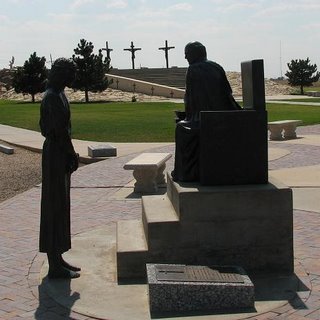
I don't mean that I saw people praying there. I don't think I did. Neither do I mean simply that it's intended for prayer, though it is. What I mean is, as I viewed the display, I was moved to prayer. I experienced this as a holy place. It caught me off guard.
Around the 190-foot cross are bronze sculptures of the stations of the cross -- nothing particularly original (the Pieta below should look familiar), but very well done. The cross in each station was wood, which is a nice touch, and they were all life-size. (Jesus was even a bit shorter than me, contrary to traditional embellishments.)
As you make the circle around the cross, you end up at a tomb, which is empty except for an angel. All of it is surprisingly tastefully done.
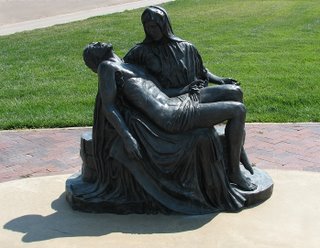
And just to put the icing on the cake, a building near the tomb contains a precise replica of the Shround of Turin and some related information. If you ever find yourself in the Texas panhandle, make your way to Groom and see this cross.
We spent the day driving along I-44 and I-40 (which have usurped the infamous Route 66) through Oklahoma and Texas, not intending to stop and see anything in particular. Then, toward the end of the day, as we were appoaching Groom, Texas, I saw a sign that said "Biggest Cross in the Western Hemisphere". I just had to see that.

I could see the cross from the spot on the road where I saw the sign, and my first reaction was, "That's not so big." It was still four miles away. It turns out it's only the second biggest cross in the western hemisphere (having since been copied and slightly enlarged in Illinois), but it's a pretty impressive sight.
Driving toward it, I expected it to be basically roadside kitsch. To my suprise, I found it to be a place of prayer.
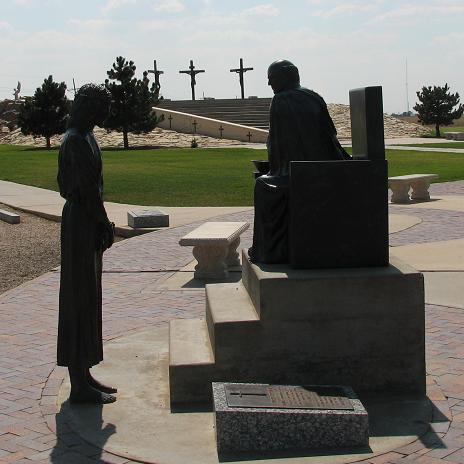
I don't mean that I saw people praying there. I don't think I did. Neither do I mean simply that it's intended for prayer, though it is. What I mean is, as I viewed the display, I was moved to prayer. I experienced this as a holy place. It caught me off guard.
Around the 190-foot cross are bronze sculptures of the stations of the cross -- nothing particularly original (the Pieta below should look familiar), but very well done. The cross in each station was wood, which is a nice touch, and they were all life-size. (Jesus was even a bit shorter than me, contrary to traditional embellishments.)
As you make the circle around the cross, you end up at a tomb, which is empty except for an angel. All of it is surprisingly tastefully done.
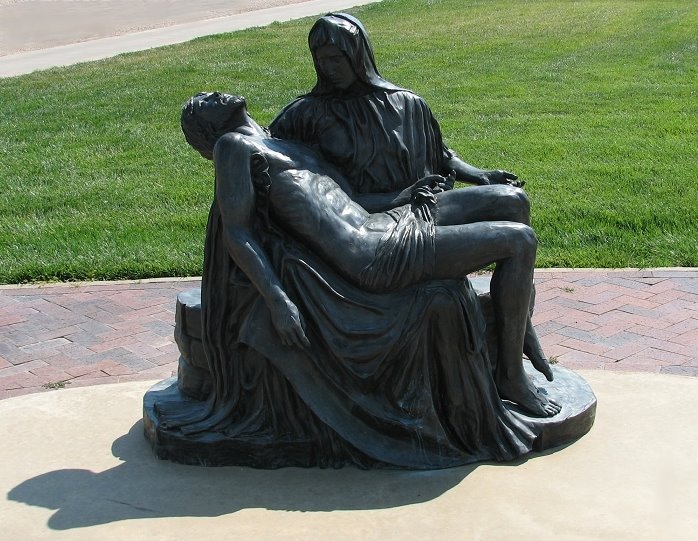
And just to put the icing on the cake, a building near the tomb contains a precise replica of the Shround of Turin and some related information. If you ever find yourself in the Texas panhandle, make your way to Groom and see this cross.
Saturday, June 24, 2006
A Simple Gospel?
In Searching for God Knows What, Donald Miller wrestles with gospel tracts based on the Four Spiritual Laws. Being an evangelical, Miller lines up along side those who use these tracts and he values them, but he isn't unaware of their limitation. Miller writes:
This is something like what I would like to have said a few months ago when I complained about what is wrong with the Four Spiritual Laws.
While the ideas presented in these pamphlets are certainly true, it struck me how simply we had begun to explain the ideas, not only how simply, but how non-relationally, how propositionally. ... The greater trouble with these reduced ideas is that modern evangelical culture is so accustomed to this summation that it is difficult for us to see the gospel as anything other than a list of true statements with which a person must agree.
It makes me wonder if, because of this reduced version of the claims of Christ, we believe the gospel is easy to understand, a simple mental exercise, not in the least bit mysterious.
This is something like what I would like to have said a few months ago when I complained about what is wrong with the Four Spiritual Laws.
Thursday, June 22, 2006
On the Road
Just as I've revealed my secret identity, I may seem to b going back into hiding. Actually, I'm just on vacation. I packed up the family and we're headed across the country.
If you're curious, you can follow our progress here
If you're curious, you can follow our progress here
Saturday, June 17, 2006
With Unveiled Face
For a little over a year now I've been writing this blog under the name Melancthon. I started it that way because that was my Beliefnet member name, and it made for a fun blog title. But I've never really liked the idea of pseudopigraphical writings, and more and more I've been feeling like I'm the only person at a party wearing a costume, so I've decided to unveil myself as it were.
Hi. My name's Andy. Nice to meet you.
Hi. My name's Andy. Nice to meet you.
Thursday, June 15, 2006
A Gift From Whoever
Last night on Fresh Air Andrew Revkin was talking about his book on an expidition to the North Pole to monitor the polar ice cap. It was an interesting interview relevant to the hot topic of global warming, but I don't have anything to say about that.
Instead I want to ponder a phrase Revkin used toward the end of the interview. He was talking what it feels like to be at the North Pole when he referred to the earth as being, and I quote, "a great gift from...uh...whoever."
This is fascinating to me -- especially the pause. Normally, I wouldn't include such a hesitation in quoting what someone said, but in this case it strikes me as being full of significance. We moderns -- people who use electricity -- haven't lost, are unable to lose, the appreciation of the world around as a great gift. But a gift from whom? We still know the answer, but it embarasses us. We think it sounds foolish to say it. So we say it is from "...uh...whoever."
But if not God, who else could give us such a gift. No matter the name you put with it, by the very fact of being the giver of this gift, the benefactor is, inescapably, God.
Instead I want to ponder a phrase Revkin used toward the end of the interview. He was talking what it feels like to be at the North Pole when he referred to the earth as being, and I quote, "a great gift from...uh...whoever."
This is fascinating to me -- especially the pause. Normally, I wouldn't include such a hesitation in quoting what someone said, but in this case it strikes me as being full of significance. We moderns -- people who use electricity -- haven't lost, are unable to lose, the appreciation of the world around as a great gift. But a gift from whom? We still know the answer, but it embarasses us. We think it sounds foolish to say it. So we say it is from "...uh...whoever."
But if not God, who else could give us such a gift. No matter the name you put with it, by the very fact of being the giver of this gift, the benefactor is, inescapably, God.
Monday, June 12, 2006
Anotioch and Alexandria
History is always instructive and Church history especially so. A lot of noise has been made in recent years about the fallacy of viewing early Christianity as a homogenous whole with one theology. Fingers get pointed at Irenaeus as the architect of orthodoxy, but even that is a gross oversimplification.
Those of us who haven't been raised to mistrust the Church have inherited a romantic notion of the early ecumenical councils from Nicea to Chalcedon where the bishops all came to agreement and the Church as one taught and practiced the orthodoxy they defined. Of course, it never happened that way.
The Council of Ephesus (431) is a particularly interesting case in point. We're told that the Council of Ephesus is the council at which the term "Theotokos" ("Mother of God") as a title for Mary received official Church blessing, and Nestorianism (the teaching that Christ existed as two persons -- a human person and a divine person) was condemned. But if you scratch just below the surface you discover that Ephesus was all about resolving a dispute between Antiochene Christianity and Alexandrian Christianity.
The council was precipitated by a feud between Cyril of Alexandria and Nestorius, bishop of Constantinople and former prodigy of Antioch. Nestorius asked the emperor to call a council to resolve the issue. The Alexandrian contingent got there first, quickly condemned Nestorius, upheld the Theotokos title and called it a day -- all this before the bishops from Antioch arrived. This is the official council of record. When the representatives from Antioch did arrive, they held their own council which condemned and excommunicated Cyril.
So far, it sounds a good bit like modern denominationalism. And I think it is. I contend that Antioch and Alexandria represented the major feature of the types of denominations that emerged from the Reformation -- namely, they each had their own theology which they held to be sacred. And in a manner worthy of the 16th century, they named anyone who disagreed with them as anathema.
But the really interesting thing about the Ephesus controversy is that they worked it out more or less to everyone's satisfaction. The leaders in Antioch agreed to dispense with the two persons doctrine while acknowledging two natures in Christ. The leaders in Alexandria agreed to dispense with their monophysite tendencies while acknowledging that Christ is one in person. The result was the formula of Chalcedon which though dressed up as dogma is really compromise. No doubt Alexandria and Antioch continued to practice and teach their distinctives, but the unity of the Church was also recognized and preserved.
Notably, many of the Alexandrian Christians felt Cyril had betrayed them by accepting this compromise and the result was one of the earliest schisms in the Church as the Coptic Orthodox Church became distinct from the rest of Eastern Orthodoxy (and still maintain that they are the ones preserving the purest apostolic tradition). I believe a similar thing happened on a smaller scale on the Nestorian side.
All of this provides a lesson that could be useful in our modern ecumenical situation. Conservatives in all branches of the Church maintain that we cannot budge on our traditional distinctives. But perhaps if we really look at what our fellow Christians in other denominations object to in our dogma we can discover that they have a point and we may even find a better way to affirm what it is our tradition is intending to preserve.
At the same time, we have the unfortunate reminder that there will be those who refuse to go along with even the best of compromises. Yet we can see that this is pretty much OK.
Those of us who haven't been raised to mistrust the Church have inherited a romantic notion of the early ecumenical councils from Nicea to Chalcedon where the bishops all came to agreement and the Church as one taught and practiced the orthodoxy they defined. Of course, it never happened that way.
The Council of Ephesus (431) is a particularly interesting case in point. We're told that the Council of Ephesus is the council at which the term "Theotokos" ("Mother of God") as a title for Mary received official Church blessing, and Nestorianism (the teaching that Christ existed as two persons -- a human person and a divine person) was condemned. But if you scratch just below the surface you discover that Ephesus was all about resolving a dispute between Antiochene Christianity and Alexandrian Christianity.
The council was precipitated by a feud between Cyril of Alexandria and Nestorius, bishop of Constantinople and former prodigy of Antioch. Nestorius asked the emperor to call a council to resolve the issue. The Alexandrian contingent got there first, quickly condemned Nestorius, upheld the Theotokos title and called it a day -- all this before the bishops from Antioch arrived. This is the official council of record. When the representatives from Antioch did arrive, they held their own council which condemned and excommunicated Cyril.
So far, it sounds a good bit like modern denominationalism. And I think it is. I contend that Antioch and Alexandria represented the major feature of the types of denominations that emerged from the Reformation -- namely, they each had their own theology which they held to be sacred. And in a manner worthy of the 16th century, they named anyone who disagreed with them as anathema.
But the really interesting thing about the Ephesus controversy is that they worked it out more or less to everyone's satisfaction. The leaders in Antioch agreed to dispense with the two persons doctrine while acknowledging two natures in Christ. The leaders in Alexandria agreed to dispense with their monophysite tendencies while acknowledging that Christ is one in person. The result was the formula of Chalcedon which though dressed up as dogma is really compromise. No doubt Alexandria and Antioch continued to practice and teach their distinctives, but the unity of the Church was also recognized and preserved.
Notably, many of the Alexandrian Christians felt Cyril had betrayed them by accepting this compromise and the result was one of the earliest schisms in the Church as the Coptic Orthodox Church became distinct from the rest of Eastern Orthodoxy (and still maintain that they are the ones preserving the purest apostolic tradition). I believe a similar thing happened on a smaller scale on the Nestorian side.
All of this provides a lesson that could be useful in our modern ecumenical situation. Conservatives in all branches of the Church maintain that we cannot budge on our traditional distinctives. But perhaps if we really look at what our fellow Christians in other denominations object to in our dogma we can discover that they have a point and we may even find a better way to affirm what it is our tradition is intending to preserve.
At the same time, we have the unfortunate reminder that there will be those who refuse to go along with even the best of compromises. Yet we can see that this is pretty much OK.
Tuesday, June 06, 2006
Theology and Psychology
Believe it or not, my previous rambling topic on free will represented the result of effort on my part to bring some focus and organization to my thoughts on the matter. At several points I had about three different and mostly unrelated directions I wanted to go with the ideas. Eventually I thought I had said as much as a reasonable person would read so I quit writing.
One thing I left out that I'd like to go back for now is the relationship between theology of free will and modern psychology. Now I don't think psychology can responsibly claim to have solved the problem of free will, but it does have some interesting things to say on the subject.
When I was a freshman in college I had to read a selection from B.F. Skinner's Beyond Freedom and Dignity. I was absolutely horrified. It was my first hint that maybe I wasn't as free as I thought I was. I took comfort in hearing that Skinner's assessment wasn't universally accepted, but the world was changed. Gradually I became indoctrinated with the view that most of our decisions are heavily conditioned by our past experiences, if not completely determined, and today I still accept this as a basic fact.
It seems to me that there is a natural application of this idea to the theology of free will, yet I don't think I've seen anything written bringing the two together.
Christians tend to have a reflexive revulsion to the idea of behaviorism. Christianity would seem to be completely invalidated if it turns out that human beings are basically just machines. And yet we have Calvinism.
Constantly lurking in Christian tradition is the idea that God is present in the world, not just where we have performed religious acts to "make" God present, not even just in the places where God has promised to meet us, but everywhere. And if we could but grasp it, there must be a connection here between the theology of free will, grace and providence on the one hand and behavioral psychology on the other.
One thing I left out that I'd like to go back for now is the relationship between theology of free will and modern psychology. Now I don't think psychology can responsibly claim to have solved the problem of free will, but it does have some interesting things to say on the subject.
When I was a freshman in college I had to read a selection from B.F. Skinner's Beyond Freedom and Dignity. I was absolutely horrified. It was my first hint that maybe I wasn't as free as I thought I was. I took comfort in hearing that Skinner's assessment wasn't universally accepted, but the world was changed. Gradually I became indoctrinated with the view that most of our decisions are heavily conditioned by our past experiences, if not completely determined, and today I still accept this as a basic fact.
It seems to me that there is a natural application of this idea to the theology of free will, yet I don't think I've seen anything written bringing the two together.
Christians tend to have a reflexive revulsion to the idea of behaviorism. Christianity would seem to be completely invalidated if it turns out that human beings are basically just machines. And yet we have Calvinism.
Constantly lurking in Christian tradition is the idea that God is present in the world, not just where we have performed religious acts to "make" God present, not even just in the places where God has promised to meet us, but everywhere. And if we could but grasp it, there must be a connection here between the theology of free will, grace and providence on the one hand and behavioral psychology on the other.
Friday, June 02, 2006
Ramblings on Free Will
Martin Luther is said to have looked back at his body of work late in his life and decided that his Bondage of the Will was one of the few things (along with the catechisms) he wrote that was worth preserving. Calvinists like to point this out. Lutherans have to live with it.
It's true that lack of free will is a cornerstone of Lutheran theology. How many times is Luther's explanation of the third article of the Creed quoted? "I believe that I cannot by my own reason or strength believe in Jesus Christ, my Lord, or come to Him..." This is a cornerstone of our theology. It's also a bit of an embarassment.
When I was in college a friend and I used to get together in various bars and talk about philosophy. It became a joke between us that no matter what topic we talked about it always came down to the question of free will. At the time, I was an unapologetic defender of free will -- completely free will to the point of making every human decision practically arbitrary. My friend, a dyed-in-the-wool post-modernist, found my position absurd (which of course it was).
Later I became a dogmatic Lutheran (really...I was). I took it as a given in theological matters that the human will is absolutely bound in matters related to salvation. This is where I now think it's a bit weird. The official Lutheran position has always been that our wills are free with regard to "things below" but that they are bound with regard to "things above" -- that I can make whatever choices I like with regard to civil righteousness, but that I cannot, apart from the Holy Spirit, come to God.
American culture will not tolerate any impingement on free will. We are, says the culture, masters of our destiny. And in the realm of religion this translates into theologies that Lutherans cannot tolerate because they are synergistic and semi-Pelagian. And most of these theologies are, in fact, objectively bad -- but not necessarily because they are synergistic.
Apart from being at odds with American cultural religion because of its position on free will, Lutheran theology is also at odds with the ancient faiths of Catholicism and Orthodoxy on these matters. Orthodoxy especially stresses cooperation with God in salvation. But Lutherans hear "cooperation with God," label it as "synergistic" and treat it as heresy.
I think this is a weakness in Lutheran culture.
I was leading a study of the Augsburg Confession once and one of the participants mentioned an idea he had heard once that the Sacrament of Communion is for Lutherans something like what altar calls are for Baptists. I liked that. A retired pastor who was in the class said that Luther wouldn't have liked that. "Why not?" I asked. He responded, "I believe that I cannot by my own reason or strength believe in Jesus Christ, my Lord, or come to Him...."
But that elipsis has content, right? It says, "but the Holy Spirit has called me by the Gospel, enlightened me with His gifts, sanctified and kept me in the true faith." We confess that we don't have the freedom to come to God on our own power, but when would we ever have to do it by our own power?
Typical Lutheran presentations make the believer (or believer-to-be) into a marionette. God pulls the strings, and we dance. We take the saying, "Apart from me you can do nothing" and make it into "You can do nothing."
The Orthodox believe that they have found the middle way between Augustine and Pelagius. Pointing to the writings of St. John Cassian, for example, the Orthodox teach that God works in and through our will to accomplish our salvation. This was judged in the West to be semi-Pelagianism.
But it's only semi-Pelagianism if you make a sharp division between the human will and the work of God and set them against one another. It seems to me that this involves a false view of the nature of God's presence in the world. If the work of God is seen as super-natural in the modernist sense of some outside action acting on nature, then you have this problem. But if you see God's work as the manifestation of God's immanent presence within the world ("in me deeper than I am in myself" as Augustine says), then the problem goes away.
It's common to here Arminians say something to the effect that God is a perfect gentleman and would never impose salvation on us against our will. That idea has always struck me as deeply flawed -- God is God and so on. But the real issue is that God doesn't need to do anything against our will, because our will is capable of being a vehicle for God's presence in our lives. And I think this is the essence of the Orthodox doctrine of synergism.
It's true that lack of free will is a cornerstone of Lutheran theology. How many times is Luther's explanation of the third article of the Creed quoted? "I believe that I cannot by my own reason or strength believe in Jesus Christ, my Lord, or come to Him..." This is a cornerstone of our theology. It's also a bit of an embarassment.
When I was in college a friend and I used to get together in various bars and talk about philosophy. It became a joke between us that no matter what topic we talked about it always came down to the question of free will. At the time, I was an unapologetic defender of free will -- completely free will to the point of making every human decision practically arbitrary. My friend, a dyed-in-the-wool post-modernist, found my position absurd (which of course it was).
Later I became a dogmatic Lutheran (really...I was). I took it as a given in theological matters that the human will is absolutely bound in matters related to salvation. This is where I now think it's a bit weird. The official Lutheran position has always been that our wills are free with regard to "things below" but that they are bound with regard to "things above" -- that I can make whatever choices I like with regard to civil righteousness, but that I cannot, apart from the Holy Spirit, come to God.
American culture will not tolerate any impingement on free will. We are, says the culture, masters of our destiny. And in the realm of religion this translates into theologies that Lutherans cannot tolerate because they are synergistic and semi-Pelagian. And most of these theologies are, in fact, objectively bad -- but not necessarily because they are synergistic.
Apart from being at odds with American cultural religion because of its position on free will, Lutheran theology is also at odds with the ancient faiths of Catholicism and Orthodoxy on these matters. Orthodoxy especially stresses cooperation with God in salvation. But Lutherans hear "cooperation with God," label it as "synergistic" and treat it as heresy.
I think this is a weakness in Lutheran culture.
I was leading a study of the Augsburg Confession once and one of the participants mentioned an idea he had heard once that the Sacrament of Communion is for Lutherans something like what altar calls are for Baptists. I liked that. A retired pastor who was in the class said that Luther wouldn't have liked that. "Why not?" I asked. He responded, "I believe that I cannot by my own reason or strength believe in Jesus Christ, my Lord, or come to Him...."
But that elipsis has content, right? It says, "but the Holy Spirit has called me by the Gospel, enlightened me with His gifts, sanctified and kept me in the true faith." We confess that we don't have the freedom to come to God on our own power, but when would we ever have to do it by our own power?
Typical Lutheran presentations make the believer (or believer-to-be) into a marionette. God pulls the strings, and we dance. We take the saying, "Apart from me you can do nothing" and make it into "You can do nothing."
The Orthodox believe that they have found the middle way between Augustine and Pelagius. Pointing to the writings of St. John Cassian, for example, the Orthodox teach that God works in and through our will to accomplish our salvation. This was judged in the West to be semi-Pelagianism.
But it's only semi-Pelagianism if you make a sharp division between the human will and the work of God and set them against one another. It seems to me that this involves a false view of the nature of God's presence in the world. If the work of God is seen as super-natural in the modernist sense of some outside action acting on nature, then you have this problem. But if you see God's work as the manifestation of God's immanent presence within the world ("in me deeper than I am in myself" as Augustine says), then the problem goes away.
It's common to here Arminians say something to the effect that God is a perfect gentleman and would never impose salvation on us against our will. That idea has always struck me as deeply flawed -- God is God and so on. But the real issue is that God doesn't need to do anything against our will, because our will is capable of being a vehicle for God's presence in our lives. And I think this is the essence of the Orthodox doctrine of synergism.
Tuesday, May 23, 2006
Verb: That's What's Happening
Well, it's taken me four months (this is what happens when I'm left to work at my own pace), but I've finally made my way through the nouns and pronouns, and I'm now ready to step into the brave new world of Greek verbs.


Friday, May 19, 2006
Deus Ex Machina
My last two posts have drawn on insights from Rabbi Lawrence Kushner, as found in his book Eyes Remade For Wonder. I have one last tasty morsel from the good rabbi that I'd like to chew on a bit before I let him move on.
Rabbi Kushner, reflecting on the story of Joseph in Genesis 37-50, observes that the whole purpose of this story is to get the Israelites into Egypt. If the Israelites don't get to Eygpt, the new Pharoah comes to power, but there are no Hebrew slaves there for God to deliver from bondage. No Hebrew slaves, no Exodus, no Passover, no Sinai, no Torah. So it's very important that the Israelites find their way to Egypt.
With this in mind, he calls our attention to a seemingly insignificant detail in the story of Joseph. Jacob sends Joseph to Shechem to check on his brothers who are pastoring their flocks in the field. When Joseph gets to Shecham, his brothers are nowhere to be found. Genesis relates the story thus:
Now this just happens to tie in with another bit of data that's crossed my inbox recently. In a theological brief issued last week, Ted Peters addresses the absurdity of the speculation that because Judas agreed (as per the Gospel of Judas) to hand Jesus over to the authorities he is responsible for our redemption. Peters uses reductio ad absurdum, claiming that he has purchased a manuscript of the Gospel of the Chief Priests from antiquities dealers, which argues that the Atonement would not have been possible if the chief priests hadn't been willing to meet Judas' asking price and that the chief priests therefore deserve credit for our redemption. But then he says he has also acquired from antiquities dealers a manuscript of the Gospel of Jesus which claims that Jesus did and said certain things that infuriated the chief priests, causing them to be willing to meet Judas' asking price. So maybe Jesus is responsible for our salvation after all.
While Dr. Peters' treatment does make clear his point that we cannot elevate anyone other than Jesus as the focus of redemption, the event inextricably involves a web of people. And this is exactly what we should expect. God's work in the world involves people, often lots of people, and many of them doing things that they probably have no idea are parts of God's work in the world. This is the way God works.
Jesus' redemption of the world is God's greatest work, and so we are naturally against attributing any part of it to anyone but Christ himself (with the exception of those bold enough to celebrate what God worked through the fiat of a young virgin in Nazareth).
This is certainly a fitting way to think of our redemption, but it can obscure our view of just how God works in the world if we use this as our template for what to expect in rest of our experience. We're looking for a glorious angel from heaven to appear and give us some message that will put us on the divine path, and so we disregard the commonplace words of a nameless man who finds us wandering in the field.
The Greeks gave us this great concept of deus ex machina. We tend to see it as a cheap plot trick to get a desired result, but it seems to have been a large part of how the Greeks viewed the world. In The Odyssey, for instance, we are told about Athena coming to speak to Telemachus disguised as Mentor. It would be easy for us to "demythologize" this and understand that Mentor just gave Telemachus some sound advice. But Homer saw divine intervention in it.
Christianity is quite content with the fact that it does not imagine superhumans on Mount Olympus intervening in our daily lives. We don't ever suspect that some god has spoken to us disguised as someone we know. We don't have that sort of superstition. But lets hope that in the process we haven't forgotten how to see God acting in the ordinary events of the world around us.
If we are to truly catch a glimpse of God in the world today, it will almost certainly be by noticing God emerging from the machine that is Creation.
Rabbi Kushner, reflecting on the story of Joseph in Genesis 37-50, observes that the whole purpose of this story is to get the Israelites into Egypt. If the Israelites don't get to Eygpt, the new Pharoah comes to power, but there are no Hebrew slaves there for God to deliver from bondage. No Hebrew slaves, no Exodus, no Passover, no Sinai, no Torah. So it's very important that the Israelites find their way to Egypt.
With this in mind, he calls our attention to a seemingly insignificant detail in the story of Joseph. Jacob sends Joseph to Shechem to check on his brothers who are pastoring their flocks in the field. When Joseph gets to Shecham, his brothers are nowhere to be found. Genesis relates the story thus:
He came to Shechem, and a man found him wandering in the fields; the man asked him, "What are you seeking?" "I am seeking my brothers," he said; "tell me, please, where they are pasturing the flock." The man said, "They have gone away, for I heard them say, 'Let us go to Dothan.'" So Joseph went after his brothers, and found them at Dothan.So Kushner claims if this nameless man didn't happen to run into Joseph in the fields at Shechem and pass along this very helpful information, Joseph would have gone back home, his brothers wouldn't have thrown him in the pit and sold him into slavery, etc., etc., and there'd have been no Exodus.
-Genesis 37:14-17
Now this just happens to tie in with another bit of data that's crossed my inbox recently. In a theological brief issued last week, Ted Peters addresses the absurdity of the speculation that because Judas agreed (as per the Gospel of Judas) to hand Jesus over to the authorities he is responsible for our redemption. Peters uses reductio ad absurdum, claiming that he has purchased a manuscript of the Gospel of the Chief Priests from antiquities dealers, which argues that the Atonement would not have been possible if the chief priests hadn't been willing to meet Judas' asking price and that the chief priests therefore deserve credit for our redemption. But then he says he has also acquired from antiquities dealers a manuscript of the Gospel of Jesus which claims that Jesus did and said certain things that infuriated the chief priests, causing them to be willing to meet Judas' asking price. So maybe Jesus is responsible for our salvation after all.
While Dr. Peters' treatment does make clear his point that we cannot elevate anyone other than Jesus as the focus of redemption, the event inextricably involves a web of people. And this is exactly what we should expect. God's work in the world involves people, often lots of people, and many of them doing things that they probably have no idea are parts of God's work in the world. This is the way God works.
Jesus' redemption of the world is God's greatest work, and so we are naturally against attributing any part of it to anyone but Christ himself (with the exception of those bold enough to celebrate what God worked through the fiat of a young virgin in Nazareth).
This is certainly a fitting way to think of our redemption, but it can obscure our view of just how God works in the world if we use this as our template for what to expect in rest of our experience. We're looking for a glorious angel from heaven to appear and give us some message that will put us on the divine path, and so we disregard the commonplace words of a nameless man who finds us wandering in the field.
The Greeks gave us this great concept of deus ex machina. We tend to see it as a cheap plot trick to get a desired result, but it seems to have been a large part of how the Greeks viewed the world. In The Odyssey, for instance, we are told about Athena coming to speak to Telemachus disguised as Mentor. It would be easy for us to "demythologize" this and understand that Mentor just gave Telemachus some sound advice. But Homer saw divine intervention in it.
Christianity is quite content with the fact that it does not imagine superhumans on Mount Olympus intervening in our daily lives. We don't ever suspect that some god has spoken to us disguised as someone we know. We don't have that sort of superstition. But lets hope that in the process we haven't forgotten how to see God acting in the ordinary events of the world around us.
If we are to truly catch a glimpse of God in the world today, it will almost certainly be by noticing God emerging from the machine that is Creation.
Wednesday, May 17, 2006
The Omnipresent Word
I concluded my previous post on awareness of God with the somewhat tongue-in-cheek observation that knowledge of God is impossible because until you become aware of God in the world you will pay no attention to sacred texts and religious ceremony and until you receive special revelation of God through Word and Sacrament you can't see God in the world.
I alluded to Xeno because just as Xeno's proof of the impossibility of motion is immediately disproven by observation, the claimed impossibility above is also disproven by experience. But it leaves open the question of just how it is the we encounter God. Again, I turn to a pair of stories from Jewish tradition as related by Rabbi Kushner.
There is a story, Kushner says, of a group of rabbis debating just what exactly the Israelites heard at Mt. Sinai. The first rabbi says that they heard the entire Torah, from Genesis to Deuteronomy. This is a solid, orthodox answer. The next rabbi said, "No, all they heard was the ten commandments." An answer much closer to the Biblical story. A third rabbi claimed that they heard only the first of the "ten words": "I am the Lord your God who brought you out of the land of Egypt." A fourth rabbi said that they heard only the first word of the first "word" -- "I" and the rest of the Torah was clear from that. Finally, a fifth rabbi argued that they heard only the first letter of the first word, aleph, an almost imperceptible sound, the sound of the opening of the throat as one is about to speak, and that this alone spoken by God was enough for them to understand all that was to be revealed.
The second story is related to this one. The second story seeks to resolve the question of whether what happened at Sinai was unique. According to one tradition, it happened only there, never to be repeated. According to another tradition, it is repeated constantly and what God spoke at Sinai, God is always and everywhere repeating. Kushner cites a Jewish source which resolves the question by saying both are correct. The revelation at Sinai was unique AND it is always being repeated. The resolution is that while this revelation is always and everywhere being spoken by God, it was only at Sinai that God allowed those present the clarity of mind and soul to hear the revelation. Kushner says it was as if God turned on the Dolby noise reduction for a moment to stop the usual hiss that deafens us.
These are nice stories. I like these stories.
So here is my Christian interpretation. The Word that God speaks everywhere and always is Christ. And so Kushner is right that through an awareness of the world around us we can meet God, and Barth is right that we can only come to know God through Christ.
But it is important to notice here, and I think Kushner would agree with this, that we do not learn about God by looking at the world. Instead, while looking at the world, we discover God in the world. God meets us in, with and under Creation.
I alluded to Xeno because just as Xeno's proof of the impossibility of motion is immediately disproven by observation, the claimed impossibility above is also disproven by experience. But it leaves open the question of just how it is the we encounter God. Again, I turn to a pair of stories from Jewish tradition as related by Rabbi Kushner.
There is a story, Kushner says, of a group of rabbis debating just what exactly the Israelites heard at Mt. Sinai. The first rabbi says that they heard the entire Torah, from Genesis to Deuteronomy. This is a solid, orthodox answer. The next rabbi said, "No, all they heard was the ten commandments." An answer much closer to the Biblical story. A third rabbi claimed that they heard only the first of the "ten words": "I am the Lord your God who brought you out of the land of Egypt." A fourth rabbi said that they heard only the first word of the first "word" -- "I" and the rest of the Torah was clear from that. Finally, a fifth rabbi argued that they heard only the first letter of the first word, aleph, an almost imperceptible sound, the sound of the opening of the throat as one is about to speak, and that this alone spoken by God was enough for them to understand all that was to be revealed.
The second story is related to this one. The second story seeks to resolve the question of whether what happened at Sinai was unique. According to one tradition, it happened only there, never to be repeated. According to another tradition, it is repeated constantly and what God spoke at Sinai, God is always and everywhere repeating. Kushner cites a Jewish source which resolves the question by saying both are correct. The revelation at Sinai was unique AND it is always being repeated. The resolution is that while this revelation is always and everywhere being spoken by God, it was only at Sinai that God allowed those present the clarity of mind and soul to hear the revelation. Kushner says it was as if God turned on the Dolby noise reduction for a moment to stop the usual hiss that deafens us.
These are nice stories. I like these stories.
So here is my Christian interpretation. The Word that God speaks everywhere and always is Christ. And so Kushner is right that through an awareness of the world around us we can meet God, and Barth is right that we can only come to know God through Christ.
But it is important to notice here, and I think Kushner would agree with this, that we do not learn about God by looking at the world. Instead, while looking at the world, we discover God in the world. God meets us in, with and under Creation.
Tuesday, May 16, 2006
Awareness of God
Rabbi Lawrence Kushner begins his book Eyes Remade for Wonder with an analysis of the story of Moses and the burning bush. Rabbi Kushner rejects the idea that the burning bush was a miracle God performed to get Moses' attention. He says you could probably buy this trick in a Manhattan joke shop -- "Bush burns but isn't consumed, amaze your friends, life of the party, $20."
Instead, Kushner suggests, the burning bush is a test to see how well Moses can pay attention. You have to watch a burning bush closely to know it isn't being consumed. So because Moses notices, God says, "To him I would speak."
The point of all this, finally, is that the first step of spirituality, according to Kushner, is becoming aware, deeply aware, of the world around us. And then, being aware, we will see God in the world. Having become aware of God's presence around us, we will at last turn to sacred texts to seek understanding.
But at this point, a lot of Christian theologians will stand up and shout, "Nein!" Only through God's self-revelation in Christ can we know God. Before Barth, we have Luther telling us, "That person does not deserve to be called a theologian who looks upon the invisible things of God as though they were clearly perceptible in those things which have actually happened." Luther here is directly relying on St. Paul's words in Romans 1:20ff where Paul says that those who sought to know God through creation became foolish and did not truly know God.
And so we must have a special revelation of God before we can know God. God must come to us in Word and Sacrament. Only then (if even then) can we rightly see God in the world.
And so we have a paradox. On the one hand, before we become aware of God's presence around us, we will have no regard for sacred texts or religious ceremonies. On the other hand, until God comes to us in Word and Sacrament, we cannot perceive God in the world.
And so, after the manner of Xeno, I conclude that knowledge of God is impossible.
Instead, Kushner suggests, the burning bush is a test to see how well Moses can pay attention. You have to watch a burning bush closely to know it isn't being consumed. So because Moses notices, God says, "To him I would speak."
The point of all this, finally, is that the first step of spirituality, according to Kushner, is becoming aware, deeply aware, of the world around us. And then, being aware, we will see God in the world. Having become aware of God's presence around us, we will at last turn to sacred texts to seek understanding.
But at this point, a lot of Christian theologians will stand up and shout, "Nein!" Only through God's self-revelation in Christ can we know God. Before Barth, we have Luther telling us, "That person does not deserve to be called a theologian who looks upon the invisible things of God as though they were clearly perceptible in those things which have actually happened." Luther here is directly relying on St. Paul's words in Romans 1:20ff where Paul says that those who sought to know God through creation became foolish and did not truly know God.
And so we must have a special revelation of God before we can know God. God must come to us in Word and Sacrament. Only then (if even then) can we rightly see God in the world.
And so we have a paradox. On the one hand, before we become aware of God's presence around us, we will have no regard for sacred texts or religious ceremonies. On the other hand, until God comes to us in Word and Sacrament, we cannot perceive God in the world.
And so, after the manner of Xeno, I conclude that knowledge of God is impossible.
Monday, May 15, 2006
Christ, Our Righteousness
I said in a previous post, "the key insight of the Reformation was that Christ is our righteousness." Some interesting discussion followed along the lines of just how far the word "our" could be stretched here.
In the new Finnish interpretation of Luther, this idea that Christ is our righteousness is pushed to its uttermost limits. In saying that Christ is present in faith itself, the Finns are claiming that our standing with God is a result of the presence of Christ in and with (and under?) the believer. The believer is treated as righteous by God because the believer, finally, is Christ.
This is taken to have some connection to the Orthodox doctrine of theosis. Athanasius said, "God became man so that man might become God." Luther said (in his lectures on Galatians), "Faith makes a man God."
One of the big difficulties with the Finnish position is that it requires us to believe that while Luther held these pseudo-Orthodox beliefs, they immediately disappeared with nary a trace in susequent Lutheranism. But there is one trace. Tuomo Mannermaa in Christ Present in Faith points to the Osiandrian Controversy.
For those without an obbsession with 16th century Lutheran dogmatics, the Osiandrian Controversy was one of the disputes meant to be settled by the Formula of Concord. Andreas Osiander disliked the idea of imputed justification. Against this idea, Osiander taught that God actually makes a Christian just through the indwelling of Christ. He was apparently opposed in this by everyone from Phillip Melancthon to Martin Chemnitz. The controversy is addressed in Article III of the Formula of Concord.
According to Mannermaa, the Formula got it wrong and thus led to the disjunction between Luther and later Lutheranism.
But Article III of the Formula of Concord provides some interesting material for reflection, particularly with regard to my claim above that "the key insight of the Reformation was that Christ is our righteousness."
In the Epitome, the FC does state clearly that "Christ alone is our Righteousness" (Article III, paragraph 1), but it is concerned with the question of what this means. This article rejects the idea that either Christ is our righteousness only according to his divine nature (the view attriubuted to Osiander) or that Christ is our righteousness only according to his human nature. The article says that Christ is our righteousness according to both natures, but then it adds "in His obedience alone." That is, it is our righteousness consists in have Christ's obedience imputed to us. At the risk of having my Lutheran membership card taken away, I'm not sure I buy this.
The Formula claims that "our righteousness before God is [this very thing], that God ... presents and imputes to us the righteousness of Christ's obedience." This has solidified into dogma in some circles. For instance, Reformed teacher Michael Horton can be heard to propound that we are saved by works, but we are saved by Christ's works not our own, Christ having fulfilled the "covenant of works" which Adam did not. This strikes me as very non-Lutheran (which is fine for Dr. Horton), but this section of the FC would seem to support it.
On the other hand, this same article of the FC-Ep says that "faith alone is the means and instrument whereby we lay hold of Christ, and thus in Christ of that righteousness which avails before God." Now this I like, and I think it has much ressonance with the Finnish idea.
The idea that we are accounted as righteous because Christ's obedience is imputed to us strikes me as theological bookkeeping. I dare say it is a theology of glory sneaking into the Lutheran confessions and becoming dogma. Against this, I much prefer the proclamation that in faith we "lay hold of Christ."
I confess to being somewhat wary of the language of Christ being present in me. There's a problem of scale here. I know that in the Sacrament we see that the finite is capable of bearing the infinite, but there would seem to be a danger here of slipping into what Mark Allan Powell calls "the image of the Microscopic Jesus" -- the idea that I may have "a very tiny Jesus inside me (sitting on that throne in my heart)." Or, much worse, the idea lends itself to the gnostic idea of a "divine spark" within each of us.
I prefer, instead, the perspective of finding myself in Christ (Col. 3:3). But I think this amounts to the same thing as the Finnish idea. And so, I would like to say (against the Formula of Concord) that our righteousness before God is this very thing, that we are found in Christ and Christ in us.
In the new Finnish interpretation of Luther, this idea that Christ is our righteousness is pushed to its uttermost limits. In saying that Christ is present in faith itself, the Finns are claiming that our standing with God is a result of the presence of Christ in and with (and under?) the believer. The believer is treated as righteous by God because the believer, finally, is Christ.
This is taken to have some connection to the Orthodox doctrine of theosis. Athanasius said, "God became man so that man might become God." Luther said (in his lectures on Galatians), "Faith makes a man God."
One of the big difficulties with the Finnish position is that it requires us to believe that while Luther held these pseudo-Orthodox beliefs, they immediately disappeared with nary a trace in susequent Lutheranism. But there is one trace. Tuomo Mannermaa in Christ Present in Faith points to the Osiandrian Controversy.
For those without an obbsession with 16th century Lutheran dogmatics, the Osiandrian Controversy was one of the disputes meant to be settled by the Formula of Concord. Andreas Osiander disliked the idea of imputed justification. Against this idea, Osiander taught that God actually makes a Christian just through the indwelling of Christ. He was apparently opposed in this by everyone from Phillip Melancthon to Martin Chemnitz. The controversy is addressed in Article III of the Formula of Concord.
According to Mannermaa, the Formula got it wrong and thus led to the disjunction between Luther and later Lutheranism.
But Article III of the Formula of Concord provides some interesting material for reflection, particularly with regard to my claim above that "the key insight of the Reformation was that Christ is our righteousness."
In the Epitome, the FC does state clearly that "Christ alone is our Righteousness" (Article III, paragraph 1), but it is concerned with the question of what this means. This article rejects the idea that either Christ is our righteousness only according to his divine nature (the view attriubuted to Osiander) or that Christ is our righteousness only according to his human nature. The article says that Christ is our righteousness according to both natures, but then it adds "in His obedience alone." That is, it is our righteousness consists in have Christ's obedience imputed to us. At the risk of having my Lutheran membership card taken away, I'm not sure I buy this.
The Formula claims that "our righteousness before God is [this very thing], that God ... presents and imputes to us the righteousness of Christ's obedience." This has solidified into dogma in some circles. For instance, Reformed teacher Michael Horton can be heard to propound that we are saved by works, but we are saved by Christ's works not our own, Christ having fulfilled the "covenant of works" which Adam did not. This strikes me as very non-Lutheran (which is fine for Dr. Horton), but this section of the FC would seem to support it.
On the other hand, this same article of the FC-Ep says that "faith alone is the means and instrument whereby we lay hold of Christ, and thus in Christ of that righteousness which avails before God." Now this I like, and I think it has much ressonance with the Finnish idea.
The idea that we are accounted as righteous because Christ's obedience is imputed to us strikes me as theological bookkeeping. I dare say it is a theology of glory sneaking into the Lutheran confessions and becoming dogma. Against this, I much prefer the proclamation that in faith we "lay hold of Christ."
I confess to being somewhat wary of the language of Christ being present in me. There's a problem of scale here. I know that in the Sacrament we see that the finite is capable of bearing the infinite, but there would seem to be a danger here of slipping into what Mark Allan Powell calls "the image of the Microscopic Jesus" -- the idea that I may have "a very tiny Jesus inside me (sitting on that throne in my heart)." Or, much worse, the idea lends itself to the gnostic idea of a "divine spark" within each of us.
I prefer, instead, the perspective of finding myself in Christ (Col. 3:3). But I think this amounts to the same thing as the Finnish idea. And so, I would like to say (against the Formula of Concord) that our righteousness before God is this very thing, that we are found in Christ and Christ in us.
Tuesday, May 09, 2006
The DaVinci Code
If you haven't seen it already, check the current issues of Sojo Mail to read their interview with Brian McLaren about The DaVinci Code. You can read it online here:
http://www.sojo.net/index.cfm?action=sojomail.display&issue=060509
(free registration required)
McLaren has a refreshing take on the DVC. Rather than seeing it as an attack on Christianity or as an opportunity for evangelism, McLaren addresses it primarily as an opportunity for the Church to reflect on how we are presenting Jesus to the culture and, as such, an opportunity for self-critique. Here's a sample:
For a while now there's been something that vaguely bugged me about the parade of books, videos and Sunday school classes "decoding" The DaVinci Code, and I think I know now what it is. In part, I just don't like anything that comes from the conservative evangelical camp (a personal bias that I realize is unfair). But it was harder to see what the problem was in this case, because I was in agreement with them that the "history" in the DVC was attrocious, and I agreed that it was worthwhile setting the record straight. So I thought my irritation was just that I didn't like the people who were writing these books.
But after reading McLaren's thoughts on the matter (as well as recent remarks from the LutherPunk), it seems to me that the public reaction of Christianity has been (surprise, surpise) self-righteous arrogance. Yes, Brown's (or more precisely, the fictional Teabing's) version of early Christian history is wildly inaccurate, but we're not going to win many friends by saying "we're right, as always, and we'll prove it."
A "just-the-facts" proof-from-history isn't what people are interested in, not least because postmodern people (rightly) don't believe that "just-the-facts" versions of history exist. I remember once when I was explaining to some non-Christian friends how the early Church determined which books should be in the Bible. When I got to the part about the rule of faith, my friends literally laughed out loud. "You mean they only picked the books that they agreed with?!" they asked. "Of course," I answered. It seemed like the most obvious thing in the world to me, but I saw why this would seem ridiculous to them, and I think it is largely because Christianity has promoted the Bible as a sort of magic book that is the standard for what's true and what isn't rather than presenting it as a book of faith. I don't think the Lee Stroebel/Hank Hanegraaff school of apologetics prepares people to really talk (and think!) about things like this. Instead, it just assures us that we are right.
In other DVC culture, did you see this week's Saturday Night Live? Tom Hanks was hosting and the intro segment was hilarious. "Audience members" including a priest and the Pope were questioning him about the DVC movie, finally culminating in a cast member dressed as Jesus who stood up for this exchange (slightly paraphrased):
I was ROFL, as they say.
http://www.sojo.net/index.cfm?action=sojomail.display&issue=060509
(free registration required)
McLaren has a refreshing take on the DVC. Rather than seeing it as an attack on Christianity or as an opportunity for evangelism, McLaren addresses it primarily as an opportunity for the Church to reflect on how we are presenting Jesus to the culture and, as such, an opportunity for self-critique. Here's a sample:
I think a lot of people have read the book, not just as a popular page-turner but also as an experience in shared frustration with status-quo, male-dominated, power-oriented, cover-up-prone organized Christian religion. We need to ask ourselves why the vision of Jesus hinted at in Dan Brown's book is more interesting, attractive, and intriguing to these people than the standard vision of Jesus they hear about in church.
For a while now there's been something that vaguely bugged me about the parade of books, videos and Sunday school classes "decoding" The DaVinci Code, and I think I know now what it is. In part, I just don't like anything that comes from the conservative evangelical camp (a personal bias that I realize is unfair). But it was harder to see what the problem was in this case, because I was in agreement with them that the "history" in the DVC was attrocious, and I agreed that it was worthwhile setting the record straight. So I thought my irritation was just that I didn't like the people who were writing these books.
But after reading McLaren's thoughts on the matter (as well as recent remarks from the LutherPunk), it seems to me that the public reaction of Christianity has been (surprise, surpise) self-righteous arrogance. Yes, Brown's (or more precisely, the fictional Teabing's) version of early Christian history is wildly inaccurate, but we're not going to win many friends by saying "we're right, as always, and we'll prove it."
A "just-the-facts" proof-from-history isn't what people are interested in, not least because postmodern people (rightly) don't believe that "just-the-facts" versions of history exist. I remember once when I was explaining to some non-Christian friends how the early Church determined which books should be in the Bible. When I got to the part about the rule of faith, my friends literally laughed out loud. "You mean they only picked the books that they agreed with?!" they asked. "Of course," I answered. It seemed like the most obvious thing in the world to me, but I saw why this would seem ridiculous to them, and I think it is largely because Christianity has promoted the Bible as a sort of magic book that is the standard for what's true and what isn't rather than presenting it as a book of faith. I don't think the Lee Stroebel/Hank Hanegraaff school of apologetics prepares people to really talk (and think!) about things like this. Instead, it just assures us that we are right.
In other DVC culture, did you see this week's Saturday Night Live? Tom Hanks was hosting and the intro segment was hilarious. "Audience members" including a priest and the Pope were questioning him about the DVC movie, finally culminating in a cast member dressed as Jesus who stood up for this exchange (slightly paraphrased):
Jesus: I've seen your movie and I forgive you.
Hanks: You forgive me for making The DaVinci Code?
Jesus: No, I haven't seen The DaVinci Code. I'm talking about The Terminal. I forgive you for making The Terminal.
I was ROFL, as they say.
Friday, May 05, 2006
Christ and Justification
As is often the case, there is some good theological discussion going on over at Without Authority, stemming from Thomas' post of some thoughts on Eberhard Jüngel's view of the Joint Declaration on the Doctrine of Justification,
Most recently, in the comments on that post, D.W. has questioned the influence that Tuomo Mannermaa and the new Finnish interpretation of Luther have had on the JDDJ and whether Lutherans should be willing to accept the Finnish interpretation at all.
As I said there, I am a big fan of the JDDJ. I also happen to be quite intrigued by the Finns' proposal, not just as it relates to Luther but also as it relates to Lutheranism as a way of thought. I think it's possible that they go too far in attributing the views they do to Luther, but quite apart from whether Luther believed what they claim, the ideas themselves are quite interesting and useful.
In one of the posts on Pontifications that turned Thomas' attention to the JDDJ and the question of justification, the Pontificator quotes John Henry Newman as asking, "what is it in a man, which God seeing there, therefore calls him righteous?"
I think there's a reflex temptation in Protestantism to give "faith" as the answer to this question. This precise answer caused a lot of problems in American Lutheranism during the predestination controversy at the end of the 19th century. But historically, Lutheranism knows better. We confess that we are saved by an alien righteousness, not because of anything which is in us. We confess that "Christ is our righteouesness," which necessarily means that faith is not.
And so, in answer to Newman's question, "what is it in a man, which God seeing there, therefore calls him righteous?" I think a good Lutheran answer is, "It is Christ!" (Interestingly, Newman gives the same answer: "This is really and truly our justification, not faith, not holiness, not (much less) a mere imputation; but through God’s mercy, the very Presence of Christ.")
But the difficulty lies in the fact that I was willing to accept Newman's question at all. I might just as well have said, "There is nothing 'in a man' which God seeing there therefore calls him righteous. It is all about Christ." The very question smacks of infused righteousness, and sets off ancient Lutheran trip wires. But is this really essential? I wonder if there isn't a danger of leaning on the extra nos formulation so much that we, ironically, separate ourselves from Christ.
The categories of infused righteousness and imputed righteousness are dusty artifacts of medieval theology, and the fact that we continue to drag them around may itself be a barrier to making progress in understanding the mystery of justification.
They key insight of the Reformation was NOT that we are saved by imputed righteousness. The key insight of the Reformation was that Christ is our righteousness, and I find Mannermaa and the Finnish school to be exploring this idea in a thoroughly Lutheran way.
Most recently, in the comments on that post, D.W. has questioned the influence that Tuomo Mannermaa and the new Finnish interpretation of Luther have had on the JDDJ and whether Lutherans should be willing to accept the Finnish interpretation at all.
As I said there, I am a big fan of the JDDJ. I also happen to be quite intrigued by the Finns' proposal, not just as it relates to Luther but also as it relates to Lutheranism as a way of thought. I think it's possible that they go too far in attributing the views they do to Luther, but quite apart from whether Luther believed what they claim, the ideas themselves are quite interesting and useful.
In one of the posts on Pontifications that turned Thomas' attention to the JDDJ and the question of justification, the Pontificator quotes John Henry Newman as asking, "what is it in a man, which God seeing there, therefore calls him righteous?"
I think there's a reflex temptation in Protestantism to give "faith" as the answer to this question. This precise answer caused a lot of problems in American Lutheranism during the predestination controversy at the end of the 19th century. But historically, Lutheranism knows better. We confess that we are saved by an alien righteousness, not because of anything which is in us. We confess that "Christ is our righteouesness," which necessarily means that faith is not.
And so, in answer to Newman's question, "what is it in a man, which God seeing there, therefore calls him righteous?" I think a good Lutheran answer is, "It is Christ!" (Interestingly, Newman gives the same answer: "This is really and truly our justification, not faith, not holiness, not (much less) a mere imputation; but through God’s mercy, the very Presence of Christ.")
But the difficulty lies in the fact that I was willing to accept Newman's question at all. I might just as well have said, "There is nothing 'in a man' which God seeing there therefore calls him righteous. It is all about Christ." The very question smacks of infused righteousness, and sets off ancient Lutheran trip wires. But is this really essential? I wonder if there isn't a danger of leaning on the extra nos formulation so much that we, ironically, separate ourselves from Christ.
The categories of infused righteousness and imputed righteousness are dusty artifacts of medieval theology, and the fact that we continue to drag them around may itself be a barrier to making progress in understanding the mystery of justification.
They key insight of the Reformation was NOT that we are saved by imputed righteousness. The key insight of the Reformation was that Christ is our righteousness, and I find Mannermaa and the Finnish school to be exploring this idea in a thoroughly Lutheran way.
Monday, May 01, 2006
In Support of Immigrants
I would guess that about a third of the people I work with are immigrants. All of them are certainly in this country legally. About half are upper-middle class white-collar workers. The other half are service workers at our facility. So today, as immigrants throughout Oregon (and other parts of the country I believe) were proclaiming a "day without immigrant workers," I was very eager to see what the workplace would be like. Can you guess?
I didn't notice any conspicuous absences among the white-collar crowd, but the cafeteria (which is run by a fairly progressive outside vendor) was running with a skeleton crew AND was serving all the food on paper plates. There was no one to wash the dishes.
Having grown-up in a community that made the ELCA look as culturally diverse as it wishes it were, I really value the diversity in my workplace and in my daughters' school. And it pains me to see America deciding that we need to clamp down our borders and only let "useful" people in.
I actually saw a newscast where "people on the street" were claiming that migrant workers from Mexico posed a threat to national security!

I didn't notice any conspicuous absences among the white-collar crowd, but the cafeteria (which is run by a fairly progressive outside vendor) was running with a skeleton crew AND was serving all the food on paper plates. There was no one to wash the dishes.
Having grown-up in a community that made the ELCA look as culturally diverse as it wishes it were, I really value the diversity in my workplace and in my daughters' school. And it pains me to see America deciding that we need to clamp down our borders and only let "useful" people in.
I actually saw a newscast where "people on the street" were claiming that migrant workers from Mexico posed a threat to national security!
Friday, April 28, 2006
On Lutheranism
The Lutheran Zepher asks, "What does it mean to be a Lutheran?"
Let me first answer, "Why am I a Lutheran?"
The first and most basic answer is that I'm a Lutheran because my grandparents were Lutheran. I was baptized into Lutheranism when I was three months old. My parents didn't drag me to church often, but we had enough of an identification with one congregation that when I wanted to play in the Sunday School basketball league, I knew where to go. And so I also joined the youth group there and went to annual LCA youth retreats (anyone else go to Crossways in Baltimore in the mid 80's?).
I don't remember what they taught me when I was a youth. I went to college with (1) a personal identity as a Lutheran and (2) the conviction that it didn't really matter if I went to church or not (I've learned as a parent that children rarely get the message you intended). So I drifted away from the Church and embraced the liberal arts mantra of the foolishness of Christianity.
But something more than that stuck somewhere deep in my sub-conscious mind. Years later, when I rediscovered Christianity, I checked out a number of denominations and their theology, and the superiority of Lutheranism was clear to me. I'd like to think, based on this, that I chose Lutheranism freely, but I'm a post-modern so I can't do that. I know too well why I chose it.
Still, regardless of what has led me to be a Lutheran, I really do like it, and so I'll return to the original question, "What does it mean to be a Lutheran?"
Obviously, what I've said to this point has some relevance to that. Being a Lutheran is something that gets into your blood and stays there. It's not just like being handed a hat that you continue to wear your whole life. It shapes you. It makes you who you are. Being a Lutheran makes you a Lutheran.
And so, for me, what it means to be a Lutheran is mostly about the way you see God. While Lutheranism can be gathered up into a tidy set of doctrines, I think it's more about a sort of intuitive feel that you develop toward Christianity. I suspect that a lot of Lutherans can't (or at least don't) even articulate precisely what this means, but when you hear something said about God, you can respond "No, that's not right!" or "Yes, that's the Gospel!" I think this is why I came back to Lutheranism. It's where I recognized the Gospel.
So what is this "je ne sais quoi" of Lutheranism? I think it's about seeing Christ as one who sets us free. We can make definitions about Law and Gospel or about Justification by Faith Alone or what have you, but if we don't see that Christ is setting us free, we aren't Lutheran.
I'm a theology geek, and I'd love to add something about the Theology of the Cross and God always coming down to us and so forth. And I think those are requisite elements of Lutheran theology, but I don't think all Lutherans are theology geeks (there's a chance I'm wrong about that), and I think the essence of Lutheranism is simpler than that.
I think there's something to the German nomenclature of Lutherans calling themselves "evangelische." Lutheranism, at its heart, is nothing more than a deep-seated passion for the Gospel, the good news that Christ sets us free.
Let me first answer, "Why am I a Lutheran?"
The first and most basic answer is that I'm a Lutheran because my grandparents were Lutheran. I was baptized into Lutheranism when I was three months old. My parents didn't drag me to church often, but we had enough of an identification with one congregation that when I wanted to play in the Sunday School basketball league, I knew where to go. And so I also joined the youth group there and went to annual LCA youth retreats (anyone else go to Crossways in Baltimore in the mid 80's?).
I don't remember what they taught me when I was a youth. I went to college with (1) a personal identity as a Lutheran and (2) the conviction that it didn't really matter if I went to church or not (I've learned as a parent that children rarely get the message you intended). So I drifted away from the Church and embraced the liberal arts mantra of the foolishness of Christianity.
But something more than that stuck somewhere deep in my sub-conscious mind. Years later, when I rediscovered Christianity, I checked out a number of denominations and their theology, and the superiority of Lutheranism was clear to me. I'd like to think, based on this, that I chose Lutheranism freely, but I'm a post-modern so I can't do that. I know too well why I chose it.
Still, regardless of what has led me to be a Lutheran, I really do like it, and so I'll return to the original question, "What does it mean to be a Lutheran?"
Obviously, what I've said to this point has some relevance to that. Being a Lutheran is something that gets into your blood and stays there. It's not just like being handed a hat that you continue to wear your whole life. It shapes you. It makes you who you are. Being a Lutheran makes you a Lutheran.
And so, for me, what it means to be a Lutheran is mostly about the way you see God. While Lutheranism can be gathered up into a tidy set of doctrines, I think it's more about a sort of intuitive feel that you develop toward Christianity. I suspect that a lot of Lutherans can't (or at least don't) even articulate precisely what this means, but when you hear something said about God, you can respond "No, that's not right!" or "Yes, that's the Gospel!" I think this is why I came back to Lutheranism. It's where I recognized the Gospel.
So what is this "je ne sais quoi" of Lutheranism? I think it's about seeing Christ as one who sets us free. We can make definitions about Law and Gospel or about Justification by Faith Alone or what have you, but if we don't see that Christ is setting us free, we aren't Lutheran.
I'm a theology geek, and I'd love to add something about the Theology of the Cross and God always coming down to us and so forth. And I think those are requisite elements of Lutheran theology, but I don't think all Lutherans are theology geeks (there's a chance I'm wrong about that), and I think the essence of Lutheranism is simpler than that.
I think there's something to the German nomenclature of Lutherans calling themselves "evangelische." Lutheranism, at its heart, is nothing more than a deep-seated passion for the Gospel, the good news that Christ sets us free.
A Human King
One of the most surprising things I found in Luise Schottroff's book on the parables was her translations including the phrase "a human king", as in Matthew 22:2, "The kingdom of heaven may be compared to the reality in the following story of a human king who made a wedding supper for his son" (a translation of Schottroff's German translation).
I'm pretty sure the bit about "may be compared to the reality in the following story" is paraphrase on Schottroff's part, and simply there to emphasize what she takes "may be compared" to mean. So I was also skeptical about "a human king." I thought this too must be a gloss. Checking a number of translations I found "a king" or "a certain king" but no "human king."
However, as you may recall, I am trying to learn Biblical Greek, one of the chief benefits of which is I it gives me confidence to look at the Greek text and see what's there. So I did. And at Matthew 22:2, I found "anthropo basilei." Hmmmm.
Now I know that a little bit of knowledge is a dangerous thing, but in my limited Greek vocabulary, I do know both of these words -- human and king.* What's more, I'm told that word order in Greek conveys emphasis rather than meaning. So if "anthropo" is possibly being emphasized, why is it dropped from most translations?
My guess is that most translators think it's unnecessary. Of course this is a human king. What other kind of king would it be? Well, in most interpretations it would be God.
But, what if the king in this parable isn't meant as a picture of God, just as the judge in the parable of the persistent widow wasn't a picture of God?
This is a prime example of the traditional intpretation being a horror show. Is this really a parable about how God will kill and torture those who insult him by refusing his invitation? Surely a human king might do that, but God?
We've touched now on the mystery of hell. This parable certainly seems to suggest something about hell, but I don't think we must see God as choosing to destroy those who reject his call like a monarch throwing a temper tantrum.
The parable speaks very clearly of how people disregard the invitation to God's feast. We make light of it. We go about our business. And even if we "go to the banquet" we may not take it seriously (the guest without a wedding garment). All these things, Jesus tells us, are going to get us into serious trouble. This is, I suppose, more a starting point for reflection than an interpretation.
I must also mention here Luise Schottroff's critique of the "ecclesiological" interpretation. There's a temptation here to anti-Jewish interpretation. It sees those first invited as the Jews, and those who subsequently go to the banquet as the Christian Church. Because those "first" invited rejected the invitation God "sent his troops, destroyed those murderers, and burned their city." Some would even say that the author of Matthew took this slant and interjected this message into Jesus' parable.
Against such interpretations we must ask, who are "those who have been invited"? Are the Jews "those who have been invited" while the Gentiles are those in the street? I don't think so. It seems to me that "those who have been invited" is a broad and inclusive term.
Who is invited to the wedding feast? All are invited! This is the very heart of the Gospel. And if the parable tells of a two-part invitation, it is only so it can teach us of two perspectives of the invitation. I also agree with Schottroff that it we would be missing Jesus' point to limit our understanding of those who accept the invitation to Christians. To say otherwise is to reduce the Gospel to a mere transaction. The Gospel is surely bigger than that.
I'm pretty sure the bit about "may be compared to the reality in the following story" is paraphrase on Schottroff's part, and simply there to emphasize what she takes "may be compared" to mean. So I was also skeptical about "a human king." I thought this too must be a gloss. Checking a number of translations I found "a king" or "a certain king" but no "human king."
However, as you may recall, I am trying to learn Biblical Greek, one of the chief benefits of which is I it gives me confidence to look at the Greek text and see what's there. So I did. And at Matthew 22:2, I found "anthropo basilei." Hmmmm.
Now I know that a little bit of knowledge is a dangerous thing, but in my limited Greek vocabulary, I do know both of these words -- human and king.* What's more, I'm told that word order in Greek conveys emphasis rather than meaning. So if "anthropo" is possibly being emphasized, why is it dropped from most translations?
My guess is that most translators think it's unnecessary. Of course this is a human king. What other kind of king would it be? Well, in most interpretations it would be God.
But, what if the king in this parable isn't meant as a picture of God, just as the judge in the parable of the persistent widow wasn't a picture of God?
This is a prime example of the traditional intpretation being a horror show. Is this really a parable about how God will kill and torture those who insult him by refusing his invitation? Surely a human king might do that, but God?
We've touched now on the mystery of hell. This parable certainly seems to suggest something about hell, but I don't think we must see God as choosing to destroy those who reject his call like a monarch throwing a temper tantrum.
The parable speaks very clearly of how people disregard the invitation to God's feast. We make light of it. We go about our business. And even if we "go to the banquet" we may not take it seriously (the guest without a wedding garment). All these things, Jesus tells us, are going to get us into serious trouble. This is, I suppose, more a starting point for reflection than an interpretation.
I must also mention here Luise Schottroff's critique of the "ecclesiological" interpretation. There's a temptation here to anti-Jewish interpretation. It sees those first invited as the Jews, and those who subsequently go to the banquet as the Christian Church. Because those "first" invited rejected the invitation God "sent his troops, destroyed those murderers, and burned their city." Some would even say that the author of Matthew took this slant and interjected this message into Jesus' parable.
Against such interpretations we must ask, who are "those who have been invited"? Are the Jews "those who have been invited" while the Gentiles are those in the street? I don't think so. It seems to me that "those who have been invited" is a broad and inclusive term.
Who is invited to the wedding feast? All are invited! This is the very heart of the Gospel. And if the parable tells of a two-part invitation, it is only so it can teach us of two perspectives of the invitation. I also agree with Schottroff that it we would be missing Jesus' point to limit our understanding of those who accept the invitation to Christians. To say otherwise is to reduce the Gospel to a mere transaction. The Gospel is surely bigger than that.
Out of Touch with the Blog World
I've been mostly out of touch with the blog world for the last couple of weeks. Besides not posting on my own blog, I've not kept up with the many quality blogs I usually read. Has anybody posted an encapsulation of the best of what's going on recently?
This week I went to Las Vegas for my neighbors' wedding. Most people get married in Vegas with just themselves and Elvis, but my neighbors invited lots of people. I love weddings, and this one, performed by a "ship's captain" on one of the boats at Treasure Island was fun, even if missing a bit of the sanctity of marriage.
Anyway, thanks to everyone who have continued to drop by in my absence. It turns out that some pretty good conversation developed in the unjust judge comments while I was away.
This week I went to Las Vegas for my neighbors' wedding. Most people get married in Vegas with just themselves and Elvis, but my neighbors invited lots of people. I love weddings, and this one, performed by a "ship's captain" on one of the boats at Treasure Island was fun, even if missing a bit of the sanctity of marriage.
Anyway, thanks to everyone who have continued to drop by in my absence. It turns out that some pretty good conversation developed in the unjust judge comments while I was away.
Wednesday, April 19, 2006
The Unjust Judge
This and a few other parables unique to Luke's gospel stand out as daring examples. It seems so impious to use an unjust judge as the centerpiece of a story to teach us about God. Who would dare it? Yet for this very reason, this parable offers insight into all the parables. It offers insight into the nature of parables.
First, despite the traditional name of the parable, the unjust judge isn't the centerpiece of this story, the widow is. Yet, by Jesus' own words we see that what we learn about God in this parable, we learn from the unjust judge.
The parable is quite clear and the application is clearly specified in both introduction and conclusion. Even so, because of the daring juxtapostion of God with the unjust judge, some interpreters have balked at the interpretation. For example, Thomas Keating (following, I believe, Bernard Brandon Scott) suggests that Luke has misapplied the parable and that it is really the widow who Jesus intends to use as the figure for God. As much as I like that idea, it isn't what the text says.
The key is this: just because the unjust judge in the parable corresponds to something Jesus is teaching about God, we need not apply all of what the parable tells us about the judge to God. This is what scholars mean when they emphasize that parables aren't allegories. For instance, while the parable surely teaches that God will answer when we persistently pray, it absolutely does not teach that God only answers to get us to be quiet. I think most of us intuitively understand that about this parable, so it serves as a useful starting point for thinking about the other parables.
The other interesting thing about this parable is that it pictures a widow asking for justice. The Old Testament prophets are constantly railing against people who refuse to give justice to widows and orphans. Because these weakest members of society are denied justice, God will act.
Imagine how different the message of this parable would be if it were about a teenager pleading with her father to buy her an iPod! But that isn't the sort of image it presents, and so I must adjust what it teaches me about prayer accordingly. Jesus says, "And will not God grant justice to his chosen ones who cry to him day and night?" This parable doesn't promise that God will grant me a comfortable life, it promises that if I pray for justice in the world, God will answer.
First, despite the traditional name of the parable, the unjust judge isn't the centerpiece of this story, the widow is. Yet, by Jesus' own words we see that what we learn about God in this parable, we learn from the unjust judge.
The parable is quite clear and the application is clearly specified in both introduction and conclusion. Even so, because of the daring juxtapostion of God with the unjust judge, some interpreters have balked at the interpretation. For example, Thomas Keating (following, I believe, Bernard Brandon Scott) suggests that Luke has misapplied the parable and that it is really the widow who Jesus intends to use as the figure for God. As much as I like that idea, it isn't what the text says.
The key is this: just because the unjust judge in the parable corresponds to something Jesus is teaching about God, we need not apply all of what the parable tells us about the judge to God. This is what scholars mean when they emphasize that parables aren't allegories. For instance, while the parable surely teaches that God will answer when we persistently pray, it absolutely does not teach that God only answers to get us to be quiet. I think most of us intuitively understand that about this parable, so it serves as a useful starting point for thinking about the other parables.
The other interesting thing about this parable is that it pictures a widow asking for justice. The Old Testament prophets are constantly railing against people who refuse to give justice to widows and orphans. Because these weakest members of society are denied justice, God will act.
Imagine how different the message of this parable would be if it were about a teenager pleading with her father to buy her an iPod! But that isn't the sort of image it presents, and so I must adjust what it teaches me about prayer accordingly. Jesus says, "And will not God grant justice to his chosen ones who cry to him day and night?" This parable doesn't promise that God will grant me a comfortable life, it promises that if I pray for justice in the world, God will answer.
Tuesday, April 18, 2006
The Parables of Jesus
I've just finished reading Luise Schottroff's book, The Parables of Jesus, newly available in English translation from Fortress Press. While I frequently found myself disagreeing with her interpretations, I learned a great deal and found her methods well worth considering.
Schottroff's basic method is to resist the traditional "ecclesiological" interpretation of the parables, seeking instead to find an interpretation that is grounded in the socio-historical relevance of the parable. She is constantly on guard against anti-Jewish and pro-patriarchal interpretations. This leads her to some understandings of the parables that are exact opposites of the traditional interpretations.
For instance, in the parable of the talents, she takes the slave who buried his talent in the ground and named the harshness of his master to be the hero of the parable. I'm not prepared to accept such radical reversals. Even so, while the effect of seeing it is jarring, it is jarring in a good way. Even if I disagree, I'm forced to reconsider my own view of the text. I can no longer take things for granted.
Most compelling is Schottroff's sensitive awareness of the terrible images that we are willing to accept as pictures of God. In the introduction she writes:
Well, sure, when you put it that way it sounds terrible. And shouldn't it? Then, once that grip has been loosened, things get interesting.
Last year, I blogged through the parables as an Easter devotion. I was going to do something different this year, like maybe the Sermon on the Mount, but I think I will have another go at the parables, seeing if I can apply some of what I've learned from Luise Schottroff to my own readings of these texts.
Schottroff's basic method is to resist the traditional "ecclesiological" interpretation of the parables, seeking instead to find an interpretation that is grounded in the socio-historical relevance of the parable. She is constantly on guard against anti-Jewish and pro-patriarchal interpretations. This leads her to some understandings of the parables that are exact opposites of the traditional interpretations.
For instance, in the parable of the talents, she takes the slave who buried his talent in the ground and named the harshness of his master to be the hero of the parable. I'm not prepared to accept such radical reversals. Even so, while the effect of seeing it is jarring, it is jarring in a good way. Even if I disagree, I'm forced to reconsider my own view of the text. I can no longer take things for granted.
Most compelling is Schottroff's sensitive awareness of the terrible images that we are willing to accept as pictures of God. In the introduction she writes:
In the doominant tradition of interpretation God is represented in these texts by the owner of the vineyard who destroys the murderous tenants, the bridegroom who excludes the "foolish" young women from bliss, and the king who kills his guests. This tradition of interpretation compels the interpreters to read a horror story as Gospel. Is God really to be compared to a king who executes his own guests?
Well, sure, when you put it that way it sounds terrible. And shouldn't it? Then, once that grip has been loosened, things get interesting.
Last year, I blogged through the parables as an Easter devotion. I was going to do something different this year, like maybe the Sermon on the Mount, but I think I will have another go at the parables, seeing if I can apply some of what I've learned from Luise Schottroff to my own readings of these texts.
Saturday, April 08, 2006
The Buzz
Courtesy of Google News, here is a sampling (intentionally biased in selection) of the online headlines regarding the "Gospel of Judas"
You can see where these stories might draw in more readers than, for example, this headline from the Seattle Times:
But my personal favorite, with Freudian significance, is this headline from the Bakersfield Californian:
"Judas did as Jesus asked – 'gospel' reveals the other face of a traitor", The Times (UK)
"Judas: this is what really happened", The Guardian
"Translated Ancient Documents Refute the Bible", Fox 12 Boise
"Gospel of Judas has Church worried", The Advertiser (Australia)
"Gospel of Judas inspires awe, wrath", Boston Globe
"Jesus asked Judas to betray him" Newindpress (India)
"Judas text sheds new light on gospels", ABC Online (Australia)
"'Gospel' truth: Judas obeyed Jesus' orders", New York Daily News
"Gospel of Judas casts doubt on traditional beliefs", CTV.ca (Canada)
"History of Christianity: The Gospel according to Judas", Independent (UK)
"Experts claim Judas was 'misunderstood'", ITV.com (UK)
"New testament: Judas redeemed", Sydney Morning Herald
"Apostle’s manuscript suggests betrayal was Christ’s idea", Chronicle Herald (Canada)
"A Real Bible Belter", New York Post
"Gospel of Judas is a Revelation", Newark Star Ledger
You can see where these stories might draw in more readers than, for example, this headline from the Seattle Times:
"National Geographic releases 'Gospel of Judas' translation"
But my personal favorite, with Freudian significance, is this headline from the Bakersfield Californian:
"Gospel insignificant, some in clergy say"
Thursday, April 06, 2006
Gospel of Judas
So, I heard on NPR tonight that a translation of the "Gospel of Judas" is being released. A fourth-century text of the gospel was found in 1978 and is now being released by the National Geographic Society.
Apparently, according to this gospel, believed to have been written in the first or second century, Judas was "in on" the secret with Jesus and given instructions to do what he did. This is an interesting, but strange, twist to the "other" gospels saga.
The modern complaint about the canonical representation of Judas is that he is an anti-Judaic personification and demonization of the Jews in general. I don't think this "new" outlook really offers an improved outlook if Judas is still taken to be a personification of the Jews. Does it, perhaps, lend credence to his reality as a historical person? I think maybe so.
The NPR story referred to the gospel as an archealogical find as important as the Dead Sea Scrolls. That is surely a gross overstatement.
Apparently, according to this gospel, believed to have been written in the first or second century, Judas was "in on" the secret with Jesus and given instructions to do what he did. This is an interesting, but strange, twist to the "other" gospels saga.
The modern complaint about the canonical representation of Judas is that he is an anti-Judaic personification and demonization of the Jews in general. I don't think this "new" outlook really offers an improved outlook if Judas is still taken to be a personification of the Jews. Does it, perhaps, lend credence to his reality as a historical person? I think maybe so.
The NPR story referred to the gospel as an archealogical find as important as the Dead Sea Scrolls. That is surely a gross overstatement.
Subscribe to:
Posts (Atom)


